To UCSF We Go: Cardiac Catheterization

On November 2nd, 2017, as we drove home from UCSF Benioff Childrens Hospital, I began a Facebook status to update our family and friends on Addison’s heart procedure.

Yep, Baby Girl aka Baby Squirrel aka Addison Elizabeth.
IMG_0605.jpg

As I rambled on I figured it would be better suited for the blog. Here it goes:

We were finally discharged at 11pm and are heading home. Addison’s procedure went perfectly, they successfully patched her ASD and PDA, and equalized the pressures in her heart from 3:1 to 1:1.

Everything went smoothly and we were reunited with her in recovery where she was still very sedated to keep her from moving her legs – the procedure was performed via her femoral artery and vein in her groin. She was required to lay still for 6 hours to allow the incision to fully clot, the first 2 hours being the most critical.

Just shy of 2 hours she awoke from sedation during an echocardiogram, and fought back when we tried to keep her legs straight. What we were trying to avoid happening happened – she started bleeding profusely and I had to apply pressure to her incision while her team was called back in to stop the bleeding.

I could only stand back and watch while they took control of the situation. In a stance I mastered in her first year of life. Arms crossed, teeth clenched, blank face, wide-eyed watching, while inside my adrenaline is tearing thru me while I fight my desire for flight.

Pressure was applied for 15 minutes to assure the bleeding stopped and additional sedatives and oxygen were given before a new bandage was applied. After the excitement was over they reassured us that it wasn’t actually that much blood. However, this bleeding restarted her 6 hour observation timer, placing our potential discharge time at ~10:30pm.

∴⇔∴

We had to check in at UCSF Benioff Children’s Hospital in San Francisco at 9am that morning, typically a one hour drive from our home but with traffic took almost two. Thankfully it had moved from 6am as originally planned.  Addison’s procedure had been scheduled the month before but was rescheduled when she started having a runny nose.  The procedure, cardiac catheterization, is an elective procedure and therefore would be rescheduled till a time she was healthy.  With cold and flu season upon us we were concerned she wouldn’t be healthy again till next spring.
This slideshow requires JavaScript.

IMG_0625.jpg

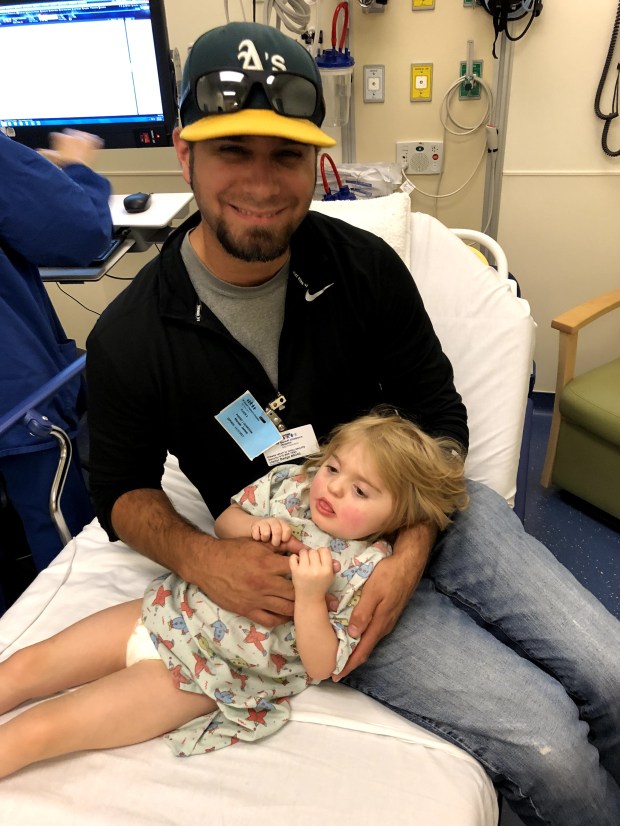
After the pre-op med kicked in. “I’ll have what she’s having.”

When the time came for the procedure to begin I suited up in a white full-body disposable jumpsuit.  [It was actually long enough on my legs to just touch the ground! I need to get that designer’s number.]  I carried her in my arms back to the lab; she was completely limp from the initial sedative but looking up at me. I laid her down and held her hand as they secured her safely to the table.  While she was still conscious I gave her a kiss on the cheek and signed to her that she was OK and I’d see her soon.  She was so relaxed she didn’t even fight the gas mask placed over her face to put her under.  I was then escorted back to the pre-op room to gather our things and return to the waiting area.

The cardiology team doesn’t even call it surgery, but rather an invasive procedure.  Due to the location of the two different holes in her heart, they had to place a catheter up her femoral artery and vein into her heart.  They then send the patching device rolled up tightly up through the catheter and place it using ultrasound imaging and witchcraft.

The procedure was expected to take 3-4 hours; a member of the team called me regularly to give us updates. I had signed a form giving my consent for Addison to be transferred to an OR for open heart surgery if an emergency arose.  We tried not to think about that.  It was a long wait, I’d only had three hours of sleep the night before. At around 2pm they called me and told me she was done and everything went perfect.  Thirty minutes later we were reunited with her in recovery.

After about an hour and 45 minutes, Addison was given an echo at her bedside to check the placement of the devices.  Everything still looked great, but then she started waking up…

As painfully slow hours ticked by, we crossed our fingers and toes that she wouldn’t start bleeding again.  We knew if she started bleeding again now we would be admitted.  We had figured we would be spending the night and came prepared; however, given the option we wanted to go home. As it got later and later we became one of the only patients left and I was fighting to stay awake.  Our awesome nurse, James, curtained off the bed next to ours (however there was no bed) and I lined up 3 chairs and laid across them and finally fell asleep for about an hour.

Her team coordinator kept reassuring us that they wouldn’t send her home unless they were completely confident that it was safe for her to leave.  The nurses continually checked her pulse around her ankles, her capillary refill in her feet, the temperature in her legs and feet, and for any other signs of blood clots.  Every time she would stir and move her legs I would jump like her incisions were a ticking time bomb.
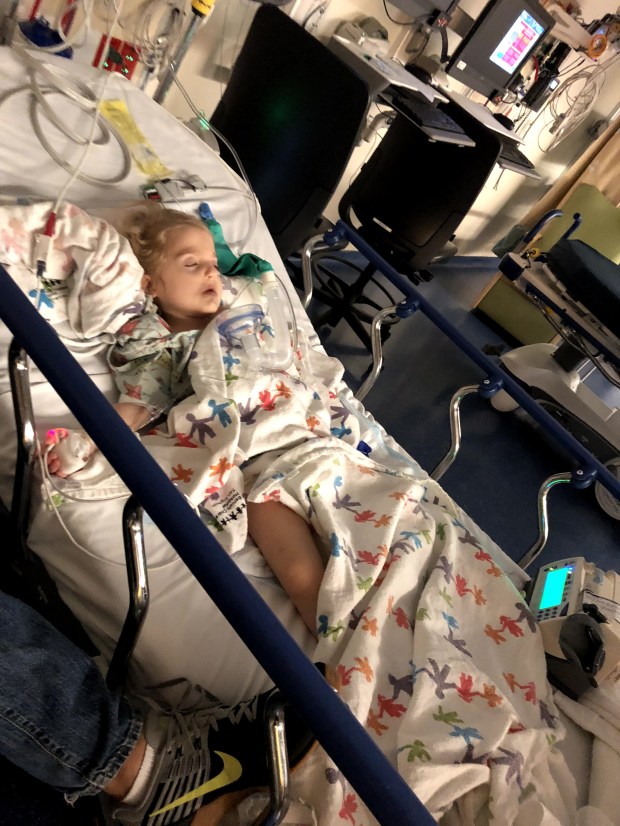
IMG_0629.jpg

Sedated AF

They weaned back her sedative and she woke up around 9pm.
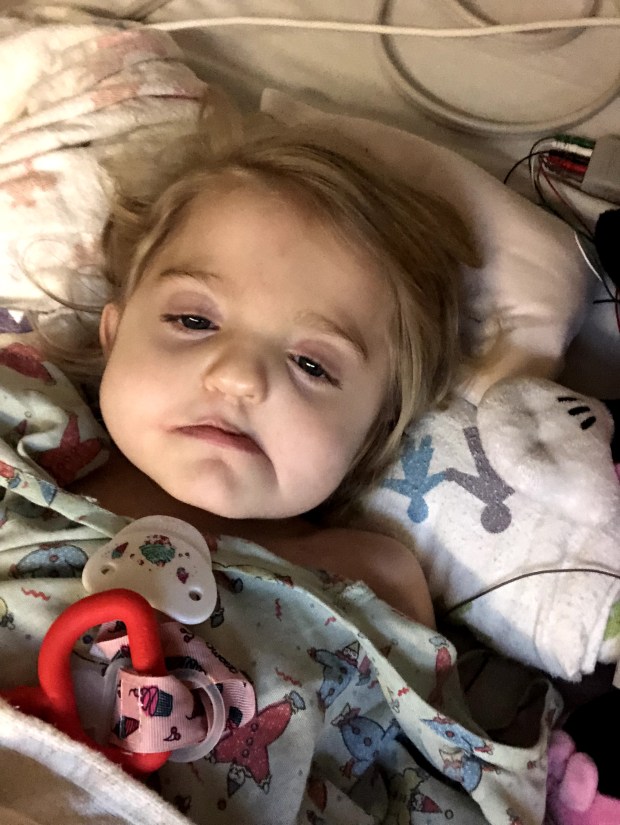
IMG_0632.jpg

Waking up

At 10pm a cardiologist gave her one last evaluation and at 10:30pm we were discharged.

They told us that sedation isn’t like real sleep for the brain and even though she “slept” all day she should still sleep well that night.  HA!  Baby girl was awake the whole drive home – she almost never sleeps in the car.  When we got home at midnight we still had to give her all her routine breathing treatments to help prevent her from getting pneumonia from laying on her back all day.  It was 2:30am when we finally went to sleep, only to wake up at 4am to Baby Girl laughing hysterically in her crib. *sigh*

∴⇔∴

The next day our village came out in full force.  One family DoorDash-ed to us bagel sandwiches and yogurt parfaits for breakfast. Another surprised Addison with balloons (which three weeks later are still floating and bringing her joy, minus one. RIP Minnie Mouse.)  And many others checked in on her and sent their well wishes which were much appreciated! Thank you to all!

As for recovery, the area was tender and she hated having her bandage changes.  A few days later I realized what I thought was the incision was just a bruise and I was putting the sticky part of the bandage on at least one of her actual incisions. =( Sorry! But that is a testament to how nearly invisible her incisions are!  On the 2nd day of recovery she began flirting with a low grade fever and we feared the inevitable infection was brewing.

Cuddles mean she’s not feeling her best.  But by the 4th day she was good as new!
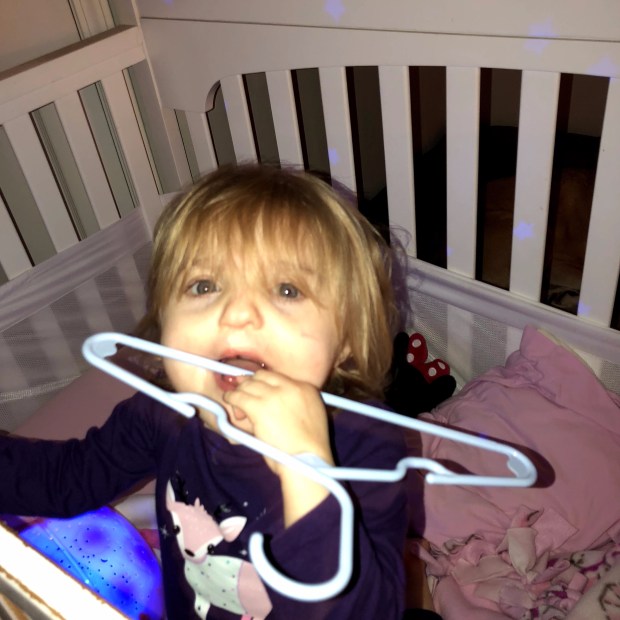
IMG_0655.jpg

A week after the procedure Addison had an appointment with her cardiologist at our home hospital.  The devices still looked great.  The procedure she had to fix the pressures in her heart is the same procedure needed to check the pressures of the heart.  Meaning in the previous three years her cardiologist could only make highly educated guesses about the amount of blood crossing over.  Turns out the pressures were higher than he thought. 3:1 opposed to 2:1. It’s science.  He gave her an A+ and will see her again in six months.
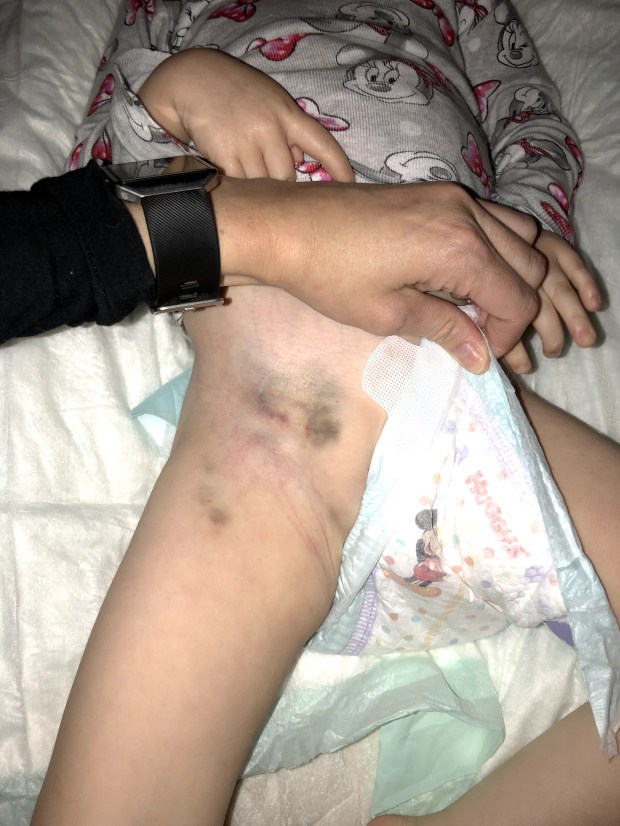
IMG_0704.jpg

Her incisions one week after. 

Processed with MOLDIV

Helmet Hair Don’t Care

This is just a short post, kind of a bonus episode if you will, to bridge the gap up to Baby Girl’s genetic testing.

A week after we learned Baby Squirrel was Deaf, we met with her Craniofacial panel of doctors and surgeons. We saw this team for the first time while I was still pregnant, after we found out via ultrasound that she had clefting.  This team included her plastic surgeon, geneticist, ENT/Head and Neck surgeon, psychologist, social worker, speech and language pathologist, orthodontist and pediatric dentist, and maxillofacial (jaw) surgeon.  After they filed in one by one to meet with us, they held a conference to formulate a complete treatment plan.

With her latest diagnosis, audiology and speech and language pathology were stricken from her treatment plan.  She will never hear and consequently will never speak so no medical intervention is necessary, just to keep working with her Early Start Deaf and Hard of Hearing program.

At the time she was 9 months old and didn’t have any teeth yet, so the oral surgeons didn’t have much to go on.  We knew from our initial meeting that they wouldn’t have much of a role until she was older, about 7-8 years old, when her adult teeth begin coming in. To bridge a cleft in the gums, currently the procedure is to take bone from the patient’s hip and implanting it in the upper jaw, grafting tissue over it to complete the jaw. (This means she’ll most likely also have some fancy veneers.)  However, new methods are advancing so there is no way to say what the procedure will be when the time comes.

After Baby Girl’s cleft lip was repaired, while we were in the PICU recovering from complications from the surgery, her plastic surgeon would routinely come check on her.  He seemed genuinely scared by her development of septic shock and declared that he was taking her cleft palate repair off the table indefinitely.  For a typical child, cleft lips are repaired when the child is 3-4 months and at least ten pounds; palates are typically repaired at 1 year of age. When we met again months later at the Craniofacial panel, he elaborated – we now had more information. Her surgeon didn’t want to close her palate because he didn’t want to risk her getting that dangerously sick again, she didn’t need it closed for speaking, she didn’t eat orally yet, and it actually helped her by giving her a larger airway.  And as an added bonus, waiting to close a palate allows the upper jaw to continue to grow naturally, while closing it can cause thick scar tissue to stunt its growth, requiring more orthodontic procedures later on.

To back up again, while Baby Girl was still in the NICU, I started to notice that her head was getting flat on one side, along with her forehead appearing asymmetrical. The nurses were good about changing her position but one side of her crib had easier access so she tended to face that way. Once she came home I tried positioning and Tortles to correct it but she had no neck control, and her airway was so fragile that limited positions were safe for her.

Fast forward to her Craniofacial panel, I mentioned this flattening of her head to her plastic surgeon and he prescribed her a Cranial Band aka a helmet. Long before marriage and kids and reality, I used to see kids with helmets and feel embarrassed for the baby and the parents. Clearly there is something wrong with the kid.  However by the time Squirrel was 10 months old, we had already experienced so much that a helmet was the least of our worries. Although I had been aware of my own previous prejudices of children with helmets, I was still caught off guard by some assumptions people had for why she had one.  I understood when people guessed if it was for seizures or epilepsy, it does look similar. However, I had adults (plural) ask me if she had it because she was missing the top of her skull… -_-
For once this poor girl had something that wasn’t medical, strictly for aesthetic purposes – I wanted her to look more normal and not have a asymmetrically flat head!

She was measured and fitted and I ordered her a light pink helmet. The makers of the helmet tried to talk me out of it.  Squirrel would have to wear it 23 hours a day, with a one hour break for baths.  And it was summer time, they are hot and get really smelly from sweating.  She was also on the older side so they couldn’t guarantee marked improvement that would be expected with say a 6 month old. But I wanted to give it a shot, she already has so many thing about her appearance that stood out, if a helmet could cross one thing off that list I wanted to try it.  At home I ordered her big bows to attach to it. She was going to rock this thing!

Photomontage time!
During this time she also had a pH probe test, you’ll see it taped to her face, but to write about it would require including a longer backstory. If you really want to hear about it please message me.  Taking Baby Girl out in public makes me extremely anxious because it feels like everyone is staring at us. On top of a baby on oxygen, add a helmet and a pH probe down her nose and taped to her face and all eyes really are on us. Some people would stare as they walked by, some people would politely smile at us, and others would blatantly walk into our path in front of our stroller to stare at her. I wanted to scream at these people.  I felt like I was being a bad mom by not scolding these people. However I realized these people honestly don’t know any better and I needed to give them grace.  I almost went as far as tattooing a reminder on my wrist but I opted for an engraved bracelet instead. The correct answer is smile, smile if you must look. Even better: smile, say hello, and ask questions!!!  I will gladly answer any questions you have about my daughter, just don’t fucking stare.

This slideshow requires JavaScript.

Bonus montage of the twins passing out in different places:

This slideshow requires JavaScript.

OK, one last one of their first birthday since I don’t feel like blogging about it:

This slideshow requires JavaScript.

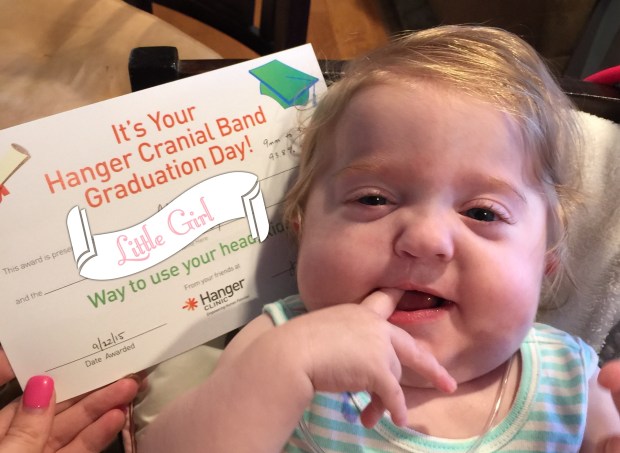
And after just 2 months, a week and a half after their first birthday, she graduated from her helmet.
Processed with MOLDIV


Coming up next:  Upon learning of her lack of auditory nerves, genetics got involved again to hopefully find out why they never formed. Since her early birth, doctors have been trying to determine whether her various conditions are due to errors in her DNA, or consequences of prematurity.  Prior to the Craniofacial panel meeting, I spoke on the phone with our geneticist. After reviewing Baby Girl’s medical record, the geneticist believed she may have a condition called 3C syndrome. She had blood taken and we waited. Three weeks later the results were back, and like most tests done on Baby Girl, the results were inconclusive:

“The testing we ordered looked at a panel of of 16 genes: AHI1, ARL13B, B9D1, CC2D2A, CEP290, INPP5E, KIAA0196, MKS1, NPHP1, OFD1, RPGRIP1L, TCTN1, TCTN2, TMEM216, TMEM67, TTC21B. The ones most associated with 3C syndrome are KIAA0196 and CC2D2A.
We received the testing result and it was negative – No sequence abnormality was detected. In other words – no spelling error was detected in any of these genes.”

Her geneticist was surprised and the decision was made to do an entire genetic testing of Baby Girl. Four months, and 20,000+ genes later, we had an answer. “Next time, on Serial.”

Processed with MOLDIV