We Finally Get A Diagnosis

Previously on “Momma Swears A Lot”:  Upon learning of Baby Girl’s lack of auditory nerves, genetics got involved again to hopefully find out why they never formed. Since her early birth, doctors have been trying to determine whether her various conditions are due to errors in her DNA, or consequences of prematurity.  Prior to the Craniofacial panel meeting, I spoke on the phone with our geneticist. After reviewing Baby Girl’s medical record, the geneticist believed she may have a condition called 3C syndrome. She had blood taken and we waited. Three weeks later the results were back, and like most tests done on Baby Girl, the results were inconclusive:

“The testing we ordered looked at a panel of of 16 genes: AHI1, ARL13B, B9D1, CC2D2A, CEP290, INPP5E, KIAA0196, MKS1, NPHP1, OFD1, RPGRIP1L, TCTN1, TCTN2, TMEM216, TMEM67, TTC21B. The ones most associated with 3C syndrome are KIAA0196 and CC2D2A.
We received the testing result and it was negative – No sequence abnormality was detected. In other words – no spelling error was detected in any of these genes.”

Her geneticist was surprised and the decision was made to do an entire genetic testing of Baby Girl. Four months, and 20,000+ genes later, we had an answer.

Four months prior we entered our geneticists office to discuss what full genetic testing would entail.  Along with Baby Girl’s blood, they would also need samples from each of us, her parents. They would not be doing genetic testing on her father and I but rather using our sample for comparison to track the line of inheritance if an error was found in her sample.  Like asking a fortune teller how you’re going to die, we signed form after form agreeing to wanting to know whatever the results may be. We also had to decide whether we wanted to know any secondary results that may be found, such as if she carried abnormal BRCA1 or BRCA2 genes, the genes typically thought to be responsible for hereditary breast cancer.  This choice also included possible medical and insurance consequences of knowing such information ahead of time.  Since the initial seed was planted in my mind that she had suffered a mutation during development the thought of childhood-cancer has also sprung up. We only wanted to do this once, we wanted to know everything.

After an excruciating 4 month wait, and calling multiple times to check on the results, I finally got the call.  The call came from the geneticist that had been with us since the beginning, since the ultrasound that initially revealed her cleft lip and palate. They had an answer.  She told me that they had found a single mutation that accounted for all her conditions and they wanted us to come in to talk about the findings – in a week and a half… Ten more days of waiting.  I made the appointment but I nearly begged her to give me any morsel of information she could.

“They found the gene responsibility for a condition called CHARGE Syndrome, like you ‘charge’ your cell phone.  As you know I always advise not to search the internet but I know you probably will.”

She went on to tell me one more thing, that the cause of her genetic mutation was “heterozygous/de novo,” meaning it did not come from me or her father but rather was a new, random mutation that likely occurred just after fertilization. In other words, before I even knew I was pregnant.  This small piece of information took so much weight off my soul.  Not just that we finally had a diagnosis but that I hadn’t done this to my daughter.  I had worried that the genetic testing would again come back with no answers and she would end up in the medical books as a new, never before seen case: “Alien Mystery Baby Syndrome.” But more importantly to me was that there was nothing we could have done to cause or prevent this.

After hanging up the phone, I sat back in my dining room chair and stared out the window. I searched for how this diagnosis made me feel.  We had desperately wanted answers for so long and they had evaded us at every turn.  Now that we had a cause, a condition, with a name, and a prognosis, the pencil sketching of what our future might look like began to look more permanent.  Immediately I consciously acknowledged that I would have to let go of the thought that all her conditions were coincidental and she would one day outgrow them and be “normal.”

Initial routine pregnancy testing had said we had a very low chance of having offspring with a genetic disorder. And later when I underwent a double amniocentesis, the chromosomal results for both twins had come back normal.  Our geneticist had warned us then that it didn’t rule out genetic disorders, but in our naive minds it did.  Since her birth the common consensus was that the remedy for most of her conditions would be time.

“Once she gains weight she’ll be fine.”

“Once she gets a little older and bigger she’ll be fine.”

“Once they send her home she’ll start catching up.”

“By the age of two she’ll be caught up and be a normal kid.”

“When she finally gets past all this stuff she’ll be just like everyone else.”

The geneticist was right, I would Google “charge syndrome”, for hours in fact.  I needed to wrap my head around what it meant before I called my husband to give him the news.  He had been my rock through everything but I knew he would need me to be his on this one.

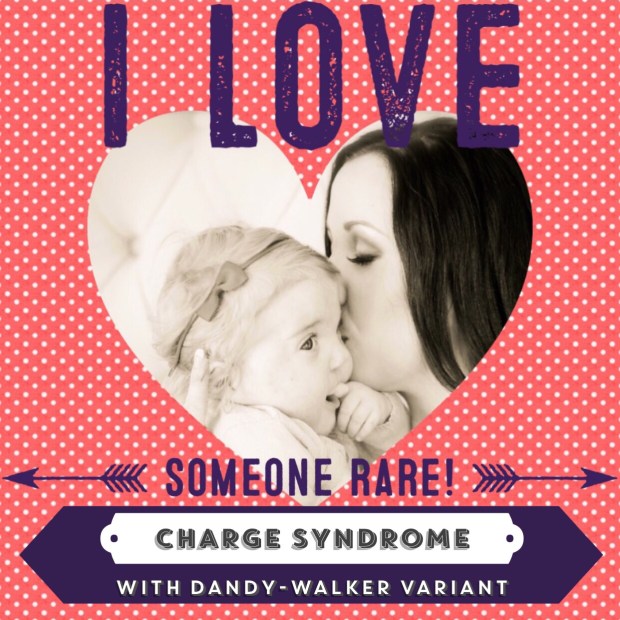
The first thing I saw was the faces of children with CHARGE syndrome. I was terrified looking at their malformed faces.  At every turn our geneticist had warned us about looking online because you are likely to find the most severe cases.  However, looking from those pictures to my girl, she didn’t look like them. She shared some of the facial features but her’s were softer, less profound.  I remember thinking how glad I was that we hadn’t received this diagnosis during pregnancy because these photos would have been even more terrifying. In Baby Girl’s case, she didn’t have every characteristic of CHARGE Syndrome, but CHARGE Syndrome explained all of her unique characteristics.

“CHARGE syndrome is a disorder that affects many areas of the body. CHARGE stands for:
Coloboma of the eye
Heart defect
Atresia choanae (also known as choanal atresia)
Retarded growth and development
Genital abnormality
Ear abnormality
The pattern of malformations varies among individuals with this disorder, and infants often have multiple life-threatening medical conditions.”
https://ghr.nlm.nih.gov/condition/charge-syndrome

*For additional information I have included a full chart of characteristic, descriptions, frequencies, and links to pictures at the bottom of this post.

The day finally came in late October 2015 to meet with our genetic team and discuss the findings.  By then I had visited countless websites, read hours worth of articles, and started to digested her diagnosis.

When our genetic team greeted us I sensed they were trying to be very gentle with us. We showed them that was not necessary.  We commented that we must be the only parents to be happy and laughing about the news of their child having a genetic disorder.  Of all the countless tests our daughter had endured, this one finally gave us an answer, a solid spot to push off from,  a game plan. Not to mention to keep her Medi-Cal coverage we financially needed a diagnosis.  They reiterated what they had told me over the phone about her condition and went over the defining characteristics.

Coloboma of the eye: clefting in the eye, she does not have this characteristic. She has since been prescribed glasses for farsightedness, but otherwise her eyes are normal. 80-90% of “CHARGErs” (people with CHARGE Syndrome) have significant vision loss or blindness.

Heart defect: she was born with a threatening VSD which defied the doctors by closing on its own in months rather than in years, as expected. She still has a PSO heart defect – typically this hole closes at birth.  She receives bi-annual echocardiograms to monitor her condition. At this time she is stable and is not in need of invasive intervention.  Continuous oxygen is required to keep her blood properly oxygenated.

Atresia choanae (also known as choanal atresia): a blockage of the nasal passage(s), usually by abnormal bony or soft tissue.  Typically this is discovered at birth as the child is unable to inhale through their nose. She does not have this condition; however, her cleft palate has been left open for the purpose of keeping an enlarged airway.

Retarded growth and development: normal birth weight is typically seen and then followed by inadequate growth.  This is most likely due to feeding/swallowing issues in infancy, which is most likely the case with Baby Girl small stature. She is currently proportionate in weight-to-height, and her weight is now good for her age but she is markedly smaller than her twin brother. He outweighs her by 8 pounds and is 5 inches taller. It is likely she will forever be smaller than her peers due to her stunted growth in infancy.
Developmental delays are especially common as CHARGErs typically have low muscle tone (hypotonia), and multiple life threatening condition at birth requiring prolonged hospitalizations. Brain and skeletal anomalies compound these developmental delays.

Genital abnormality: visible abnormalities are more common in males, Baby Girl does not have this characteristic.  However, they may experience delays in puberty, or need hormonal therapy to initiate puberty. Kidney anomalies are also common.

Ear abnormality: anomalous ear lobes, cochlear abnormalities, balance problems, hearing loss. Kind of, yes, yes, and yes.

Since the designation of the CHARGE nomenclature, additional common characteristics have been attributed to the syndrome:
– Choanal atresia or stenosis: decreased/absent sense of smell
– Cranial nerve problems: facial palsy, hearing loss, undeveloped auditory nerve(s), swallowing problems, reflux, sinus problems
– Cleft lip and/or palate
– Dental problems
– Behavioral concerns
– Brain anomalies: Dandy-Walker Variant in Baby Girl’s case
– Increased pain threshold: potential superhero

And after the geneticists explained all of that, they gave us the Secondary Findings: None.

As wonderful as finally having an answer was, please don’t underestimate our grief.  Learning that our daughter had a genetic disorder and would never be “normal” fucking sucked.  It’s terrible to have to ask if your child’s life expectancy will be shortened. (The answer being baring complication due to her existing conditions, her life expectancy is apparently normal.)  It’s fucking unfair. It is so unbelievably fucking unfair. One in every 10,000 births – not the jackpot I ever dreamed of winning.  If she has children someday the odds are 50% her offspring will have CHARGE Syndrome.

I am not a believer of “Everything Happens For A Reason.” It sucks this happened to our family, it’s fucking unfair, and it hurts everyday.  I don’t believe there is a reason for any of it.  And please please please please please PLEASE don’t try to point one out to me. There are just no words to mend some injuries.

The diagnosis changed the way I looked at her. At first it felt like a veil of expectations had been lifted. She was free to be whatever she was going to be. At first I looked at her with pity, this poor little broken baby of mine. However I think it made me love her more. It allowed me to understand her better.  I still have high expectations for her but when she actually accomplishes them it gives me an unbelievable high for days.

The prognosis for every CHARGEr is different and unforeseeable. The verdict is still out for her cognitive ability.  I don’t like to skip ahead but the twins were recently assessed as part of their high-risk status of prematurity – our healthcare provider will closely follow their development till the age of three.  Baby Boy scored average across the board, and above average in fine and gross motor skills. Proud mama bear over here! They admit their test does not accommodate for hearing loss, and therefore Baby Girl scored in the low average range – which is encouraging.  They expect that as her communication skills improve through acquisition of sign language, as well as fine and gross motor skills/strength, that this score will increase.  We will meet with a communication specialist in the near future to better assess her skills.   They will be tested again in a year, before their third birthday.

I included this information to stress that my daughter is not “retarded.”  Yes, she has a major, complex genetic disorder. Yes, she is extremely medically fragile. Yes, she has developmental delays.  No, she can’t hear you. But she is watching, and she is learning, and she is much more intelligent than most people give her credit for. As I have mentioned before, I am hyper-aware of how people explicitly and unconsciously act around her.  Most outings make me want to scream because people either won’t look at her, walk in a big circle around her, frown at her, or say something along the lines of “poor baby.” UGH!!!!  I know children (and adults for that matter)  with special-needs make most people uncomfortable, and my daughters medical conditions can make her especially scary at times, but she’s so fucking awesome too. My mommy wish as she gets older is for more people to be able to see that.  Like every child, some days they drive you crazy, push you to the breaking point of your mental and emotional sanity, but at the end of the day you couldn’t imagine loving a tiny human any more than you love them.
 

IMG_5817

I tried to keep the genetic information as laymen as possible. Please know, like most genetic conditions, it is extensively complex and cannot be completely, and fairly, explained in this one article.

This post is dedicated to a tiny family in our lives going through a similar experience. It flipping sucks and it’s not fair.  You may feel lonely but you are not alone.  We each process this news in our own time. We love you! – G, J, A & A

Processed with MOLDIV

*Major Features of CHARGE Syndrome (very common in CHARGE and relatively rare in other conditions)

FEATURE INCLUDES FREQUENCY
Coloboma of the eye Coloboma (sort of like a cleft) of the iris, retina, choroid, macula or disc (not the eyelid); microphthalmos (small eye) or anophthalmos (missing eye): CAUSES VISION LOSS
Pictures
80%-90%
Choanal atresia or stenosis The choanae are the passages that go from the back of the nose to the throat. They can be narrow (stenosis) or blocked (atresia). It can be unilateral (one-sided) or bilateral (both sides), bony or membranous.

Unilateral atresia or stenosis can be difficult to diagnose
Pictures

50%-60%
Cranial nerve abnormality I – Missing or decreased sense of smell 90-100%
IX/X – Swallowing difficulties, aspiration  – Pictures 70%-90%
VII – Facial palsy (one side or both)  –  Pictures 40%
CHARGE outer ear Short, wide ear with little or no lobe, “snipped off” helix (outer fold), prominent antihelix (inner fold) which is discontinuous with tragus, triangular concha, decreased cartilage (floppy), often stick out, usually asymmetric –  Pictures >50%
CHARGE middle ear Malformed bones of the middle ear (ossicles): CAUSES CONDUCTIVE HEARING LOSS Common
CHARGE inner ear Malformed cochlea (Mondini defect); small or absent semicircular canals: CAUSE HEARING LOSS AND BALANCE PROBLEMS  –  Pictures 90%

Minor Characteristics of CHARGE: Significant, but more difficult to diagnose or less specific to CHARGE

FEATURE INCLUDES FREQUENCY
Heart defects Can be any type, but many are complex, such as tetralogy of Fallot 75%
Cleft lip +/- cleft palate Cleft lip with or without cleft palate, cleft palate, submucous cleft palate  –  Pictures 20%
TE fistula Esophageal atresia, Trancheo-esophageal fistula (TEF), H-shaped TEF 15-20%
Kidney abnormalities Small kidney, missing kidney, misplaced kidney, reflux 40%
Genital abnormalities Males: small penis, undescended testes
Females: small labia, small or missing uterus

Both: lack of puberty without hormone intervention

50%
25%

90%

Growth deficiency Growth hormone deficiency 15%
Other short stature 70%
Typical CHARGE Face Square face with broad prominent forehead, arched eyebrows, large eyes, occasional ptosis (droopy lids), prominent nasal bridge with square root, thick nostrils, prominent nasal columella (between the nostrils), flat midface, small mouth, occasional small chin, larger chin with age. Facial asymmetry even without facial palsy  –  Pictures
Palm crease Hockey-stick palmar crease  –  Pictures 50%
CHARGE Behavior Perseverative behavior in younger individuals, obsessive compulsive behavior (OCD) in older individuals >50%

Other Features of CHARGE: consistent with CHARGE, possibly medically significant, but less helpful in making a diagnosis

FEATURE INCLUDES FREQUENCY
Chronic ear problems Lots of infections, fluid in the ears, PE tubes until teens 85%
Sloping shoulders Underdeveloped shoulder muscles, small or missing pectoral muscles, short neck  –  Pictures Common
Limb/skeletal Absent thumb, extra fingers, vertebral abnormalities ?
CNS abnormalities Hydrocephalus, seizures, abnormalities seen on MRI or CT Occasional
Thymus or parathyroid abnormality Small or missing thymus, decreased immune system Rare
Omphalocele Omphalocele or umbilical hernia 15%
Nipple anomalies Extra, missing or misplaced nipples Occasional
Hypotonia Low muscle tone  –  Pictures 90%
Scoliosis Usually due to low muscle tone Common

No one feature is required to make a diagnosis of CHARGE. Every feature varies from severe to absent in different children.
-http://www.chargesyndrome.org/about-charge.asp

My Daughter Is Deaf

A month after Baby Squirrel was discharge from the PICU after nearly succumbing to septic shock and double pneumonia, we were back at the hospital for a sedated hearing test. The goal being to keep her completely still so we could finally get reliable results.

I was rather optimistic.  We figured she had some hearing loss but we knew she could hear.  I told her primary NICU nurse that there was a chance Baby Girl was Deaf and she reaffirmed that she was not Deaf, that she loved her music in the NICU and always responded to her daddy’s voice. Even the audiologist that attempted to check her hearing while she was sedated in the PICU believed she could hear because Baby Girl turned towards her when she entered her room out of her line of sight.

My best evidence for her hearing was at home one night when I was putting her to bed, my husband, who was downstairs, spoke through the baby monitor and Baby Girl started looking behind her for him. Yet there were other times when she was napping in the living room and I dropped a pan loudly on the ground and she did not stir.  Evidence for her lack of hearing I chopped up to her being used to so many loud noises from her long stay in the NICU.

Baby Squirrel’s procedure took place in the same department as my D & C had a year and a half prior. Everyone commented on her being the littlest patient they had in quite a while. Even the smallest infant size gown they had hung off of her. In the photo below you’ll notice she was off oxygen.  Around this time she was able to come off often and use it only at night while she slept. Now a year later, this nearly never happens. She’s much bigger now and with the increase in size comes an increase in our hopes that she would be outgrowing her lung disease.  If she comes off oxygen now, even for a few minutes, the oxygen in her blood desaturates and she struggles to breathe and turns mottled and blueish. At the current age of 1 1/2, they now expect her to need oxygen till the age of three. *sigh*

IMG_9997

When the time came, we went into the procedure room and I sat with her while the nurse tried to start an IV. The attending physician was one of Baby Girl’s PICU doctors (now I jokingly call him “Uncle Ben”).  When the doctor and the audiologist were ready I was sent back out to the waiting room to, ya know, wait.

The test took about an hour and then I was brought back into her room for the results. Baby Squirrel’s hearing loss was “Profound.” Meaning she can’t hear. Anything.  They tested both ears up to 120 decibels, equivalent to a jet taking off – painfully loud for a person of “normal” hearing. Nothing. The test rendered no response.  My heart sank a little but I remember not being surprised.  The audiologist said she may have some success with hearing aids, and if we wanted additional testing, an MRI could tell us if she is a candidate for cochlear implants.  Before the audiologist left she told me to keep talking and singing to her.

“A cochlear implant is a small, complex electronic device that can help to provide a sense of sound to a person who is profoundly deaf or severely hard-of-hearing. The implant consists of an external portion that sits behind the ear and a second portion that is surgically placed under the skin.”
-National Institute on Deafness and Other Communication Disorders

ear_works2

How cochlear implants work


Typically, to avoid major speech and language delays in a child with hearing loss, it needs to be identified and hearing aids need to be in place by six months of age. Baby Squirrel was now over 7 months old.

A few weeks later I took her to get fitted for hearing aids.  She absolutely hated the forming putty being injected into her ear, she screamed and thrashed. This audiologist was so patient and kind, considering both twins were screaming their heads off. I ordered Baby Squirrel hot pink hearing aids – if you can’t hide it, rock it!  As we waited for her hearing aids to be made, we moved forward with having an MRI of Baby Girl’s brain.  The MRI would look for the presence of her auditory nerves.  It was scheduled for my 30th birthday. I prepared for the best birthday present, or the worst.

IMG_0758

After MRI and a lot of attempted IVs

IMG_0761

Baby Boy had lots of kisses for his sister when we got home

The MRI went smoothly.  Our favorite doctor from the PICU, Dr. F,  was the attending physician. After, when I was allowed to go back and see my daughter, she was happy and smiley, obviously still enjoying the sedatives. She was covered in tape and gauze where they had attempted multiple IVs since her veins were still so small. Unfortunately, I would have to wait for the ENT specialist to review the images before I would be informed of the results. I emailed her to make sure she saw that the MRI images were ready for her, and sat back and waited to hear from her.

Nothing that day.

Nothing that night.

Nothing the next morning.

So many hopes and dreams depended on these results!

Still nothing.

That night in the middle of my workout session, my phone finally rang.  I was annoyed that she had picked this time to finally call but I was relieved it was her, the ENT.

“I had a chances to review your daughter’s scans…It looks like your family should start learning to sign…I do not see an auditory nerve on either side.”

“Okay…” I said staring out the window at our unmanicured backyard.

The ENT continued to explain that due to the absence of Baby Girl’s auditory nerves, she was no longer a candidate for cochlear implants. Without the auditory nerves there was no path for the implants to communicate sound to her brainstem.  She mentioned a new alternative option called an ABI but stated Baby Girl was probably not a candidate for that either due to her Dandy-Walker Syndrome variant.

An auditory brainstem implant (ABI) is a small device that is surgically implanted in the brain of a deaf person whose auditory nerves are lacking or damaged. The auditory nerves conduct the sound signals from the ear to the brain. The implant enables otherwise deaf people to have a sensation of hearing.

The hearing sensation is limited, but the implant recipients are relieved of total sound isolation, facilitating lip-reading.

The auditory brainstem implant consists of a small electrode applied to the brainstem, a small microphone on the outer ear, and a speech processor. The electrode stimulates vital acoustic nerves by means of electrical signals and the speech processor digitally transmits the sound signals to a decoding chip placed under the skin. A small wire connects the chip to the implanted electrode attached to the brainstem. Depending on the sounds, the electrode delivers different stimuli to the brainstem making deaf people hear a variety of sounds.

Due to the brain surgery required for the implantation and the limited effectiveness of the implant, the number of implant recipients is small.

http://www.hear-it.org/auditory-brainstem-implant

So that was it. Our daughter was deaf and there was nothing we could do to change that.

I’m guessing you are wondering, as we were, then why did everyone think she could hear? Why did she respond to sounds that were out of her line of vision?  Why did everyone report how much she loved her music?  Welcome to the club! And that is why Baby Girl/Squirrel has another nickname: Alien Mystery Baby.  Nothing about her seems to make sense, she leaves many of her doctors scratching their heads, and most tests leave us with more questions than answers. I’ve had doctors ask out of medical curiosity if they could follow her for their own education. I used to like to joke that someday her condition would end up in medical books bearing her name: [Baby Squirrel] Syndrome.

When I got off the phone with the ENT I expected to cry but I didn’t.  As I try to remember what my immediate feelings were, my chest fills with weight.  I had been trying to prepare myself for this possibility for weeks, months, but I was pissed.  We were devastated.  I know that to the Deaf community, that can be offensive, but Paul W. Ogden, author of The Silent Garden: Raising Your Deaf Child acknowledges that your child’s deafness is a crisis, at first.

“…a crisis is an occurrence that permanently alters our understanding of reality; frequently it is an event we have not anticipated or prepared for.  Something happens that throws everything we know, feel, and understand about our lives and those around us into a new light. I don’t have to tell you that learning of your child’s deafness is this kind of experience… For the child who has been deaf from birth or shortly thereafter, nothing has altered.  For you, life has changed permanently… Simply understanding that you are in the process of adjusting to a fundamental change in reality can be helpful.”

The best way I can describe it is, every time we get a new dire diagnosis for Baby Girl, I mourn the loss of the life I had envisioned for her.  Starting with the first diagnosis of a cleft lip in utero, I mourned her perfect face, adorable newborn photos, happy smiles, a normal appearance that wouldn’t give kids an added reason to make fun of her. I had to exchange those images I had dreamed of for many painful surgeries, years of speech therapy, dental surgeries, multiple cosmetic surgeries, all in the hope that someday people won’t notice she was born imperfect. I have lost the life I envisioned for her countless times.

“Losses are…occurrences or events that shatter dreams that are core to a person’s existence…  The initial diagnosis often marks the point when a cherished and significant deam has been shattered for the parent… The parent oftentimes does not understand that it is a dream that he has lost, and therefore he is frequently confused by the grief process that follows.”

-Kenneth L. Moses, psychologist

We didn’t want to tell anyone that our daughter was Deaf at first; we didn’t want it on social media.  We called and told close family members and everyone was sad.  Probably a month or more went by before we told ourselves our daughter is Deaf and that’s not going to change, so why hide it?

The whole time in the NICU, what got me through was the thought that someday she could tell me she was OK. I know that her inability to speak won’t keep her from being able to tell me that someday, but the vision was to hear her voice. Now it feels like everything is thrown up in the air.  The twins are now a year and a half old and our hearing son is signing but Baby Girl shows very little interest. More recently she enjoys watching people sign the ABC’s, 1-10, and my made up “Good Night”song for her when I tuck her in at night. She likes holding hands and touching faces, but most of the time she won’t look at you when you want her to and will pull her hand away if you try to help her make sign shapes. It breaks my heart when I see other twins babbling back and forth.  How much I wish that was A & A; I eagerly await the day they sign back and forth. Thinking about it just makes me more anxious about Squirrel’s lack of interest in communicating.

When we tell people she is Deaf, the usual response is something like, “really? Aww, I’m so sorry!”  And we dive into our spiel about how the Deaf community doesn’t consider being Deaf a disability, how we’ve always wanted to learn sign language, how we’re excited to have a bilingual family, yadda yadda yadda. Sometimes I feel that way, but sometimes I hate it. Some people apologize for trying to talk to her verbally, don’t apologize, we still do too.  Whenever there is tragedy or sadness people always try to say magical reassuring phrases. Don’t do that. But I’ll get into that in a future post. One that we get often is along the lines of future technologies, “Well in the future I’m sure they’ll have someway to make her hear.” Maybe, but most likely she wouldn’t benefit from it.  She was born Deaf, she’s never heard a sound, ever.  Her brain is being mapped for visual information. If she heard sound, in say 20 years, her brain wouldn’t know what the hell to do with it.  She would need years of therapy to learn how to hear, what sounds mean.  I hope that if that technology ever is available that by then she is so well adjusted she wouldn’t need to subject herself to the hassle.

I have so much to say here and nothing.  My feelings regarding my daughter’s deafness is fluid and evolving.  This part of our story has such a far way to go. Sometimes I truly am optimistic about it.  This is the best time ever to be born Deaf; with so much of our communications digitalized already, job are limitless. But I’m still scared about where she will fit in in life.  Deaf children are more likely to have other disabilities than the general population; however, the Deaf community has also worked very hard for generations to dispel the notion that Deafness in itself is a disability, and therefore some try to distance themselves from Deaf people with disabilities so as to not be perceived as a disabled person by association.*

When Baby Girl was discharged from the NICU, she was enrolled in many state and federal funded programs due to her prematurity and health issues.  Shortly after she was discharged from the PICU, the Early Start Program, in conjunction with the San Andreas Regional Center (SARC), sent interventionist to our home once a week to play with and observe and assess Baby Girl’s development.

The Early Start Program is California’s response to federal legislation ensuring that early intervention services to infants and toddlers with disabilities and their families are provided in a coordinated, family-centered system of services that are available statewide.

Once we learned she was Deaf, SARC transferred her from the county level Early Start program to our local school district with interventionist and teachers for children with hearing loss. An Individual Family Service Plan (IFSP) is created every 6 months to formulate developmental goals for Squirrel based on her own abilities.  Now once a week her teacher/interventionist comes to “play” with her and track her development. And every other week her awesome ASL teacher comes and works with all of us.  She shared with me that she gets really excited when a new Deaf child enters their program, but has to remind herself the parents might not feel the same way.

Processed with Moldiv

Baby Squirrel at 9 Months Old

It’s not all bad.  It is fun learning ASL, I just wish it wasn’t because we HAVE to.  And it’s helpful having Baby Boy be able to tell us what he wants since his verbal vocabulary is still small. It’s just one more thing on top of the mountain of other things.  I am relieved she’ll never have to endure those school bus hearing tests though.  From unrelated causes, I have poor hearing and the school bus tests were always humiliating for me when I was the last student let off the bus.  There are definitely pros and cons to Squirrel’s deafness.

  • Pros
    • She can sleep through anything
    • We don’t have to watch what we say around her – For example…
    • We can mute Caillou
    • Our protective dogs don’t wake her when people fail to read our “No Solicitors” sign
    • She could get a service dog someday!
  • Cons
    • We can’t get her attention if she can’t see us
    • We can’t startle her out of a bad behavior by yelling
    • You can’t communicate while doing other tasks with your hands
    • She won’t be properly embarrassed by our “80s on 8” renditions
    • She runs the risk of not overhearing enough dysfunction to be funny

Our house is covered in Sign labels.


Aside from my friend’s stepdad in elementary school, my daughter was the only other Deaf person I had ever met. Watching my friend sign with her family had left an impression on me, and ever since I had always wanted to learn sign language.  In college I tried to take American Sign Language but I couldn’t register because I was not a Special Education major.

Over the past year we have tried multiple avenues to learn sign language.  We had to first decide whether to learn American Sign Language (ASL) or Signed Exact English (SEE).  ASL is a fully formed true language with its own grammar and syntax, where SEE is English with a sign for every word. We ultimately decided that it was most important to give Squirrel a basis in real language and chose to learn ASL.  My older sisters and one of my nephews are learning SEE at our local school for the Deaf and Hard of Hearing. My nephew tells me everytime I see him that he hopes Baby Girl learns to sign and her oxygen and feeding tube goes away so she can have a normal life. *tear*  He’s 8 and he told me he was so sad when he found out she couldn’t hear. Me too, Buddy.

My husband and I tried online tutors, and watching DVDs, but being in the house with the kids is too much distraction.  This spring semester I began taking an ASL course at our community college. Three hours every Monday night.  It’s already been so helpful to get out of the house and immerse myself in the class without interruption.  My professor is Deaf and speaking is forbidden in class.  I was surprised by how much I already know.

I didn’t actually get into the class at first.  I was 6th out of 13 on the waitlist, and she only ended up taking the first four.  Since it was the first day of class most communication was written on the chalkboard.  I got up and wrote asking if I could audit the class, just sit in the back and watch.  She signed no, there was no room, nothing she could do. So I put down the chalk and I signed, “My daughter is Deaf.” She told me to sit down and handed me an add code at the end of class! The Deaf culture is collective, they take care of their community and share any information they can to help Deaf people communicate and interact with the hearing world around them.  By helping me she’s helping my daughter.

I’m not one to believe in fate or really anything divine, but something along the way happened that I truly am thankful for, and kind of in awe of how perfectly these people came into our life. While I was pregnant our hospital enrolled us in a prenatal group called “Centering.” It was awkward at first but we were all due around the same time so slowly we bonded over common pregnancy symptoms, and the dads bonded over how crazy all the moms were. Just kidding, they bounded over sports and other off topic subjects. There was even another couple having twins.

I was the first one to pop. But exactly a week later, while we were visiting our babies in the NICU, we ran into a couple of familiar faces.  The other couple with twins delivered their boys at 32 weeks and they were also in the NICU. We got closer over time, mostly from seeing each other in the NICU all the time, and going through a similarly difficult situation. It was nice to have people we knew there.

After all the Centering group babies were born everyone met back up for a reunion, Baby Boy was home by then.  We exchanged information and started meeting once a month for playdates.  These families have turned into an extended family to us and our kids: aunties, uncles, best-friends growing up together since before they were born.

The coincidently perfect part is, the mother of the twin boys has many Deaf family members and was raised with ASL as her primary language.  You know who you are, and it still makes my eyes misty to remember the first time we brought Baby Squirrel to your house, and as we were leaving you knelt down infront of her car seat and signed to her.  I have no idea what you said, nor is that important.  But I don’t think you have any idea what that meant to me. Thank you.

This chapter is open ended – this part of our journey is still just beginning.  Stay tuned for updates.  Including upcoming posts about more things for people to stare at, and getting a genetic diagnosis!!!!!!!

Processed with MOLDIV

*If you have a child recently diagnosed with hearing loss, I highly recommend reading The Silent Garden: Raising Your Deaf Child, by Paul W. Ogden.

I Got The PTPPNICUDSD Blues!

Post Traumatic Postpartum Neonatal Intensive Care Unit Depression Stress Disorder

OK, maybe I made that up.  But I wasn’t just effected by the twins emergency 9 week early arrival, or their 4.5 months in the NICU, or the wild hormonal changes swirling through my brain and body after pregnancy; they all played a nasty game together.

Few people know many details about our 133 day stay in the NICU because it got to a point where it was too painful to continually tell people our daughter wasn’t any better, or she was continually getting worse, or she had received another dire diagnosis. We appreciated everyone caring enough to ask but they most likely received a lie in response. “She’s doing alright,” “she’s still technically premature so she still has a long way to go,” “her lungs just need to get stronger and she’ll be home,” “eh, she’s getting there.”  I rarely to never shared photos of our daughter during this time because, quite frankly, she looked like shit.  I’ll do my best to not make this post horribly depressing but the truth is I am still profoundly effected by our experiences over the last year and a half. And I still struggle with depression every single day.

When the twins were born on September 3rd, 2014, 9 weeks early by emergency C-section, I didn’t get to see them for the first time till the next day.  They were still an abstract idea to me; you know you’re pregnant but you’ve never seen them outside your body before so you don’t really know who you are missing. I even still felt their fantom kicks. I was in so much pain I was switched to Percocet and kept in a sleepy haze.  Most mothers will probably disagree but I loved having a catheter in because it meant I didn’t have to get out of bed.  (I had to pee and then I didn’t anymore. It was fantastic.) My husband had seen our children when he escorted them to the NICU where he fought with the nurses and doctors to get them placed next to each other rather than in two completely separate areas.

While I was in recovery he spent time with the twins and took pictures but he refused to show me until I was able to see them in person. All I knew for almost 24 hours was that my son had dark hair like his daddy and my daughter had strawberry blonde hair like me. And that her face was completely open on her right side due to her cleft lip and palate. We knew she would have the clefts before she was born but we were never able to see if her lip was open all the way up through her nose or not.  Every 2-4 weeks I was given a 3D ultrasound to try to see her face (moms of typical children are probably envious of that), but she always either had her face up against the membrane that separated her from her brother, which made the image look like she had a veil over her face, or her brother’s butt was in the way.

The day after their birth it was my mission to get out of bed and into the wheelchair so I could go see my babies. Holy fuck! You really don’t realize how every move you make uses your core until your core has been sliced open and stapled back together.  It took two people and a lot of crying but I made it into the wheelchair and over to the NICU.  We had always known that with twins it was almost a guarantee that one or both would spend at least some time in the NICU; however, I was extremely naive of how that would actually effect us.

Their first 4 days in the NICU are kind of a blur for me. I was on heavy painkillers and spent my time there fighting the nods while peering through the little door/windows in the side of their isolettes, cupping Baby Girl’s head in my hands, or sitting next to Baby Boy’s isolette holding his tiny fingers sobbing because every breath he took looked like his ribs collapsed to his spine. It would be 5 days before I was able to hold my son for the first time, and 10 days before I could hold my daughter.  You may notice I talk about my son much less than I do my daughter. Once my son’s lungs opened up he was able to breathe on his own.  For the rest of his time in the NICU as long as we let him sleep on his tummy he was happy.

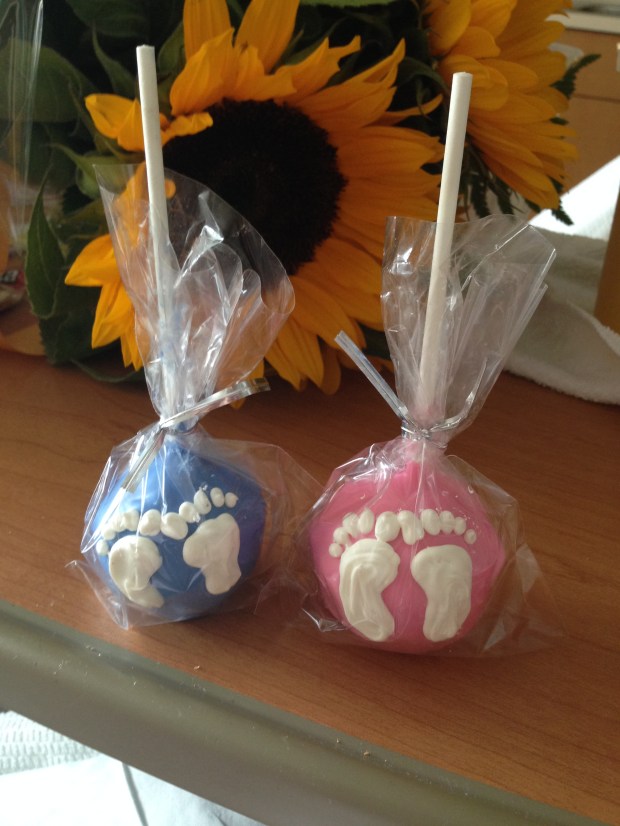
Because they were 9 weeks premature the doctors expected them to remain in the NICU for 4-6 weeks.  Because we knew we were in for the long haul we showered the NICU nurses with Starbucks coffee and giant gourmet cake pops made by a close friend who was a pastry chef.  My charming husband made sure all the nurses and doctors knew us all by name so they would consciously, or at least subconsciously, take the best care of our babies when we couldn’t be there.

IMG_5748

The massive sunflowers hide that these cake pops were huge!

I remained in the hospital for 5 days, before being discharged. I got my wheelchair ride out but my arms were empty.  I sobbed all the way home leaving our babies behind.  I don’t think that crying ever really stopped after that.  I woke up crying, I pumped crying, I fell asleep crying. I relied on my husband for everything. Physical support, emotional support, and he carried it all like the Titan Atlas.

Pumping, pumping, pumping, pumping, pumping, pumping, pumping, pumping. Fuuucckkkk pumping.  Pumping 8-12 times a day, every 2 hours, roughly a 40 minute routine. Do the math with me here, that’s nearly a minimum of 6 hours a day. But not just during the day – around the clock. And the 2 hours starts when you start pumping, so really you only have an hour and change between pumps. I killed myself for that milk and it always made me feel like a complete failure. I could never produce enough for both.  When I would take that sweet liquid gold into the NICU the nurse taking it would always say, “thats all? Are you pumping at least 8 times a day?” I wanted to be a breastfeeding mother, my goal was at least a year. I knew it would be hard but it’s fucking hard!  I tried everything. Supplements, massage, “Power Pumping”, I was spending that 6+ hours a day online researching how to up my supply. My daughter would never be able to breastfeed due to her cleft lip & palate, and my son would end up taking 8 months to figure out milk came out of those things! 8 months! ANYONE that says “don’t cry over spilled milk” has never been a lactating mother!

For the first week home, we would get up and go to the NICU, spend all day there and then come home and do it all over again the next day. The NICU at our hospital was a level III NICU but the babies did not have private rooms. There were 4 main rooms called Pods: Pod A, B, C, and D, and each pod had 6 isolettes/cribs. You could pull a curtain for “privacy.”  The nurses had shift change every day at 7am, 11am, 3pm, 7pm, and 11pm.  At those times all parents had to leave the NICU for 30 minutes before they could come back in; you couldn’t stay with your child around the clock.

After a week I was healed well enough to care for myself and get around on my own. My husband returned to work so he could save his paternity leave for when the twins came home.  I was so scared to be alone. I had become completely dependent on him.  I was constantly crying and sad and he was constantly reassuring me and trying to ease my fears. All the stress surrounding babies that could have torn us apart had brought us exponentially closer.

I delved into a routine in an attempt to keep my sanity. Every morning when my husband left for work I would get up, pump, then head to the hospital to deliver milk. I would stay for 9am rounds where the doctors and staff would come around and talk about all the scary stuff wrong with our children, particularly our daughter. Blood clots in the brain, hydrocephalus, inability to feed, failure to thrive, heart murmurs.  I would stay till about 11:30am then head home. I would drive back to the hospital again at 4:30pm to meet my husband and we would stay till shift change at 7pm then head home and start dinner.

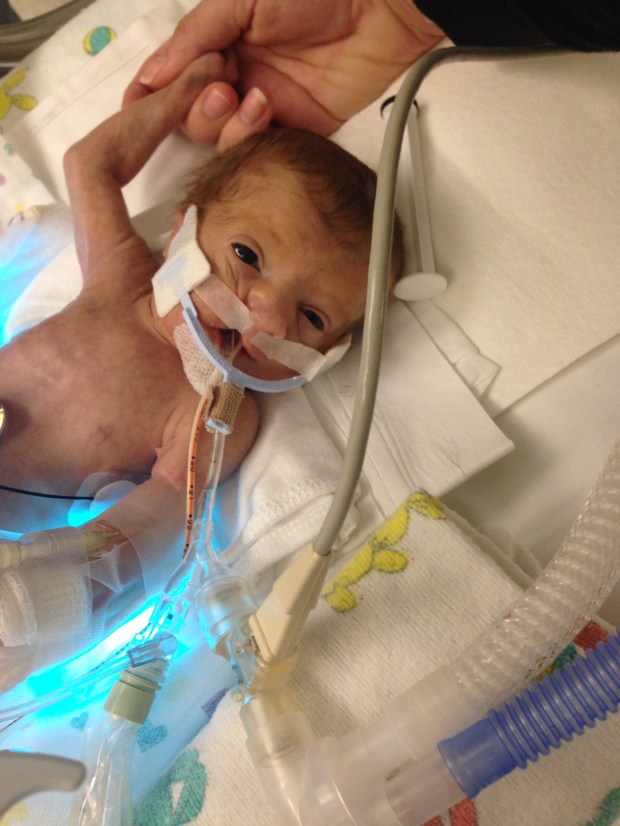
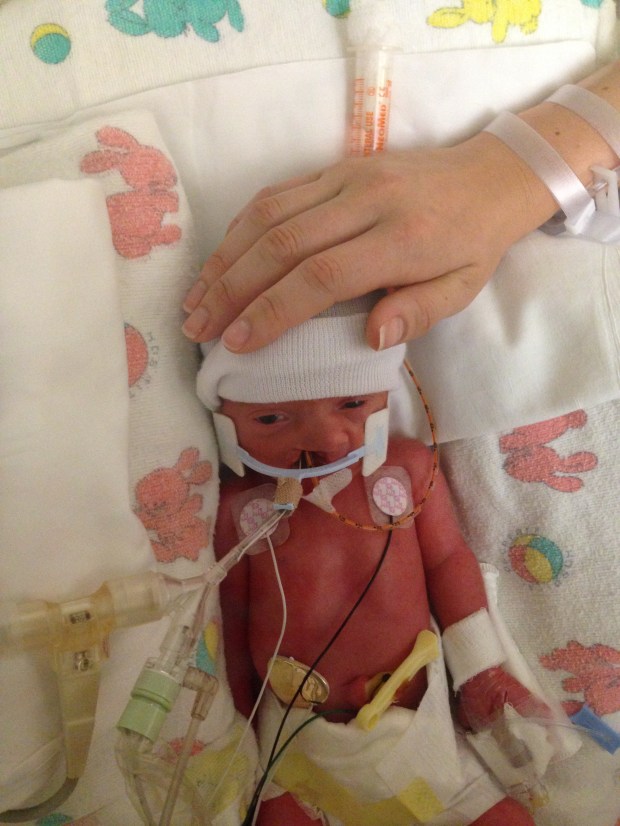
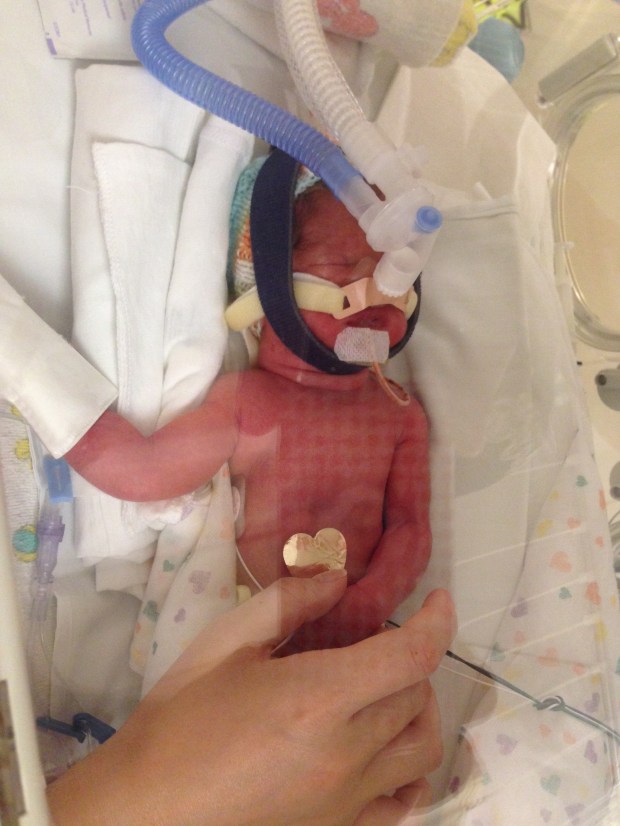
During the 2nd week our daughter stabilized enough to be held.  I was terrified. She had so many tubes and wires and cords attached to her and she was just so tiny.  Looking back at photos I can now see how mottled her skin was and why the doctors were so concerned about her coloring. Shortly after she was put in my arms she refluxed and threw up all over me. The bile itself I didn’t mind. It was the vision of it coming out of her mouth and nose because of her clefts. It gushed out of her entire face and then she would choke and turn blue and the monitors would start screaming. Those goddamn monitors. Constantly going off. Today I can read those monitors upside down and backwards, but then I didn’t know what they meant and the sound always scared the hell out of me. Every time one would go off I would jump.  And because the pod was open I could hear all the other babies monitors, and sometimes I couldn’t discern immediately if something was wrong with my babies or someone else’s.  Most premature babies have a feeding tube in their nose down to their stomaches.  When my daughter’s reflux could not be managed and continued to be threatening her doctors opted to move her feeding tube past her stomach and into her intestine with an x-ray guided weighted tube with the goal of reducing the amount of content in her stomach. Like most things with our daughter we would learn, it only helped a little.  I just kept telling myself that someday I’ll get to hear her little voice tell me she’s OK. I’ll explain in a later post why that will never happen.IMG_5763

One doctor noticed that I would always cry when we spoke after rounds, or any time for that matter. She always asked if I was OK and offered to have a social worker come talk with me.  I always said I was fine, I was just scared, and I didn’t want to talk. After a male doctor (let’s call him Dr. K) bluntly told us our daughter had a hole in her heart and would probably require open heart surgery, my husband had privately requested that the doctors speak with more tact around me. However, one day we were told Baby Girl had fluid pooling around her brain causing added pressure.  I remember our primary nurse hugging me for the first time and that I felt things must be much worse than they are letting on in front of me. I asked to speak to the doctor that always checked on me and told her I was ready to talk to someone. I was set up with appointments to speak with a therapist and a psychiatrist.  I didn’t want medication but I was instructed to keep the appointment anyhow. I don’t even like taking Motrin for headaches till I’ve at least tried to drink it away with water.

Three weeks doesn’t sound like a long time now but by their third week I was losing it.  I wasn’t sure if my daughter was going to ever leave the hospital alive, I was only sleeping and hour or 2 tops at a time, I felt nauseous all the time, postpartum morning sickness as I began to call it, and mentally I was a complete wreck. Imagine every negative emotion coursing through you all at the same time constantly for over 20 days straight. Sadness, fear, anxiety, worry, exhaustion, disappointment, regret, loss, inadequacy. And I don’t mean like I was bummed out or feeling blue. My chest ached with deep terrifying sadness and fear. I felt completely useless to my children.  I regretted having them at all.  I showed up to the NICU multiple times a day but I didn’t want to be there.  I pumped nonstop for them but I fucking hated myself when 30 minutes later I only had an ounce or two to take to them.  When doctors would talk to me I could only nod and fight back the tears, I couldn’t contribute to the conversation or to the care of my children. Every time those motherfucking monitors would go off my heart would race and I would go into fight or flight mode. And one day I snapped.  Both of my children’s monitors kept going off, back and forth, loud piercing beeps in the mandated quiet of the NICU. I wanted to get up and run out of there but instead I grabbed my phone and penned a desperate email to my OB.

Processed with MOLDIV

My desperate plea to my OB

My OB headed a special prenatal group we attended and we got to know each other very well, much more so than just occasional check ups. So she wasn’t just passing out pills just because I asked.  She prescribed me Zoloft and I picked it up that night. Zoloft is in no way a quick fix. In fact it makes things worse before they ever get better.

I had agreed with my therapist that I would attend a Postpartum Depression support group.  I didn’t think it was the right fit for me but I agreed to check it out.  **In advance, mothers, please forgive me for my thoughts I am about to share from this time. I know any mother can experience PPD, no extraneous circumstances necessary.** The group consisted of about 10 women, all but myself and one other mother had their babies there with them, all singletons under 6 months. We moved clockwise around the group introducing ourselves and sharing what we were struggling with.  The first mom was beautiful and put together, hair done, light makeup, well dressed.  She talked about how she had got to go out with her girlfriends over the weekend and how nice it was but how the baby woke up at 2am that night wanting to be feed and that was stressful for her.  The next mom shared that she couldn’t get any friends or family to come over and help give her a break from her baby, her son nursed while she spoke. Another shared that her son was born 11 days early but did not have to spend any time in the NICU and she was sad all the time, and that her husband had earlier that day watched their son so she could get out and get a pedicure. I wanted to scream at these pathetic women, “You have your healthy child attached to your tit right now, what the fuck are you crying about?! I would give ANYTHING to be in your shoes. My children are fighting a possibly losing battle for their lives right now!”  I didn’t of course. Instead when it was my turn I started hyperventilating/ugly-crying halfway through my name.   I bawled out my situation and vowed to myself I wasn’t coming back.  The poor girl after me said she had the “postpartum blues.”

The first 10-14 days on Zoloft were the worst. I didn’t think it was possible but everything negative intensified, even the nausea. After about two weeks everything finally began to improve.   I met with my psychiatrist and we increased my dose over time to an effective level.  I am not ashamed to admit that I am medicated.  It is the best thing I have ever done for my kids and marriage.  Once the medication took effect I could control my emotions.  I could hold a productive conversation with the doctors and discuss my children’s care without crying.  I could think reasonably and logically.  And best of all I began to see the positive sides of everything; I saw everything as blessings in disguise.  Every time my husband and I had received bad news, we made “positive positive positive” our mantra, and now I could really live it.  I wasn’t manic by any means, I still felt sadness and anxiety but at a manageable level.   My husband recently told me in the past he thought people that needed antidepressants were weak but after our experience he saw that some people really do need them and they can help immensely.

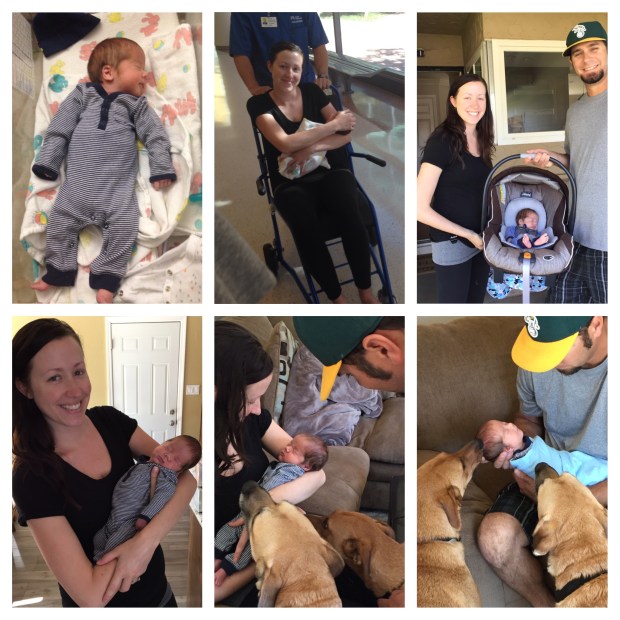
During those long two weeks, after 31 days in the NICU, our son came home. He was technically still only 35 weeks and tiny, just over 6 pounds. Leaving the hospital with our son was even harder than the day I was discharged after their birth.  I felt like we were abandoning Baby Squirrel.  She was still so little and sick and we were going home and being happy with our healthy baby boy. Every joy felt like a betrayal to her.  It was like living in two different worlds. In the NICU everything was solemn, but at home we were making memories and becoming a family.  Our son was growing and developing and thriving and the gap between him and his sister was growing larger.

Processed with Moldiv

Baby Boy’s Homecoming

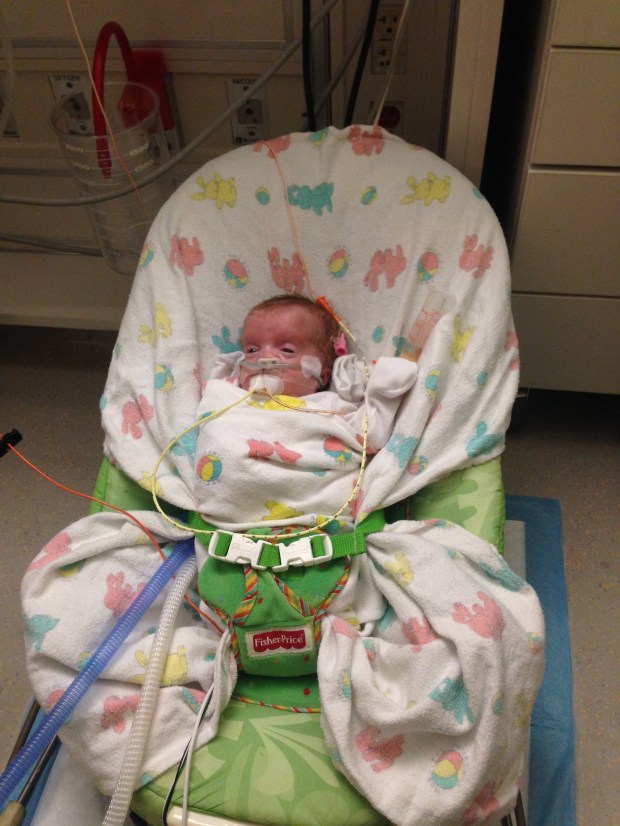
 When Baby Girl was nearly 40 weeks old they moved her out of the typical isolette and into a crib.  We brought every stimulus we had.  A mobile with colorful birds for her to look at and reach for, pictures of us and high contrast images to tape to the sides, a vibrating chair, and an iPod and speaker full of calm upbeat and relaxing music.  She loved her music. Her nurses kept it on for her quietly 24/7. Every day the nurses would tell us how much they loved all the Beyonce, I accidentally put 3 copies of “Halo” in her mix. And they always commented on how much Baby Girl loved her music, how she perked up when it came on. Six months later on my 30th birthday we would learn how ironic their comments were.

IMG_6677

IMG_6565All progress with Baby Girl was painstakingly slow. Even with the feeding tube down in her intestine she was still refluxing and aspirating.  She was always going up and down on oxygen support.  Due to her prematurity she has chronic lung disease, her lungs are riddled with scar tissue and continually fill with fluid, requiring more and more diuretics to dry them out.  She had regular echocardiograms to watch how her heart and lungs played together.  (My heart is currently pounding in my chest as I try to formulate this next sentence…) At two months old she was diagnosed with Congestive Heart Failure. Without knowing what that meant, it sounded like a death sentence, right?! “Heart Failure.” That super vital organ that keeps you alive, hers was failing.
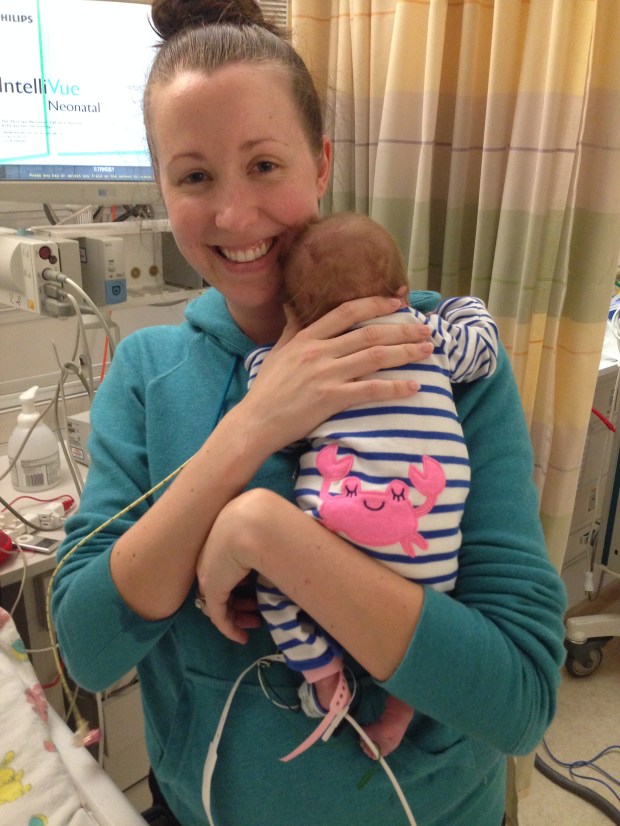
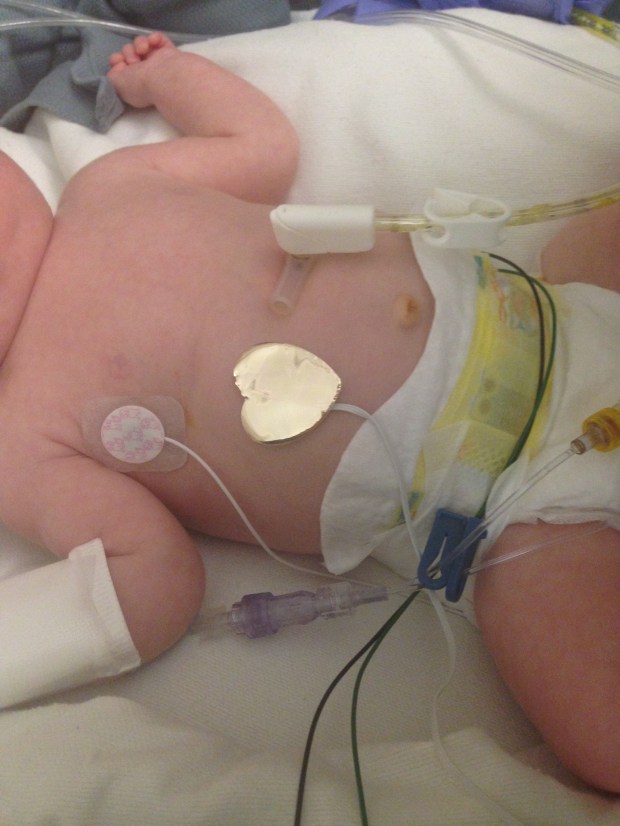
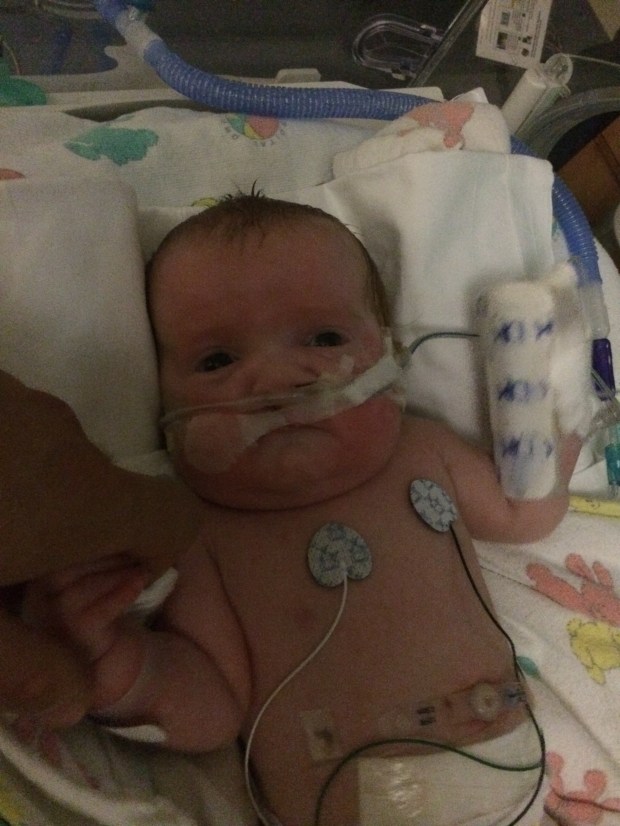
I think I shut down.  I don’t remember much after hearing that. I can’t remember if I was just numb from the daily stream of bad news or if I was protecting myself for her possible demise. I think that was the universal tipping point; the universe decided we’d earned a miracle.  During a follow up echo a couple days later the cardiologist found her VSD, the large hole in her heart that Dr. K said would require open heart surgery, and that the cardiologist later refuted but said would take years to close, had closed seemingly over night.  Before telling us the cardiologist had other cardiologist confirm it because he did not believe what he was seeing.  Later that day at rounds, Dr. K said, “I’m not supposed to say this but she must have a lot of people praying for her.”

We rode that high as long as we could.  But Baby Girl’s reflux was not improving.  Dr. K proposed giving her a g-tube and tracheotomy. We refused.  I adamantly did not want my daughter to have a g-tube.  The thought of them cutting open her perfect, soft, smooth belly skin was unbearable.  Just the sheer thought of it made my eyes well up and spill over.

In early/mid November all the nurses went on strike.  Due to the delicate nature of the NICU, the nurses brought in travel nurses and quietly warned all the parents so they could prepare.  For 48 hours my husband stayed with her to make sure there were no set backs due to nurses that were inexperienced with her very particular care instructions. For 48 hours he stayed with her, sleeping in a straight backed chair and leaving only at shift changes.  This ended up being a blessing in disguise as the travel nurse that had our daughter taught us how to take care of our daughter, and further more, she let us. By the end of the two days we felt much more comfortable with her routine care.IMG_6879

The discussion over a g-tube and trach continued for days before my husband made it very clear that the word “tracheotomy” was not to be uttered ever again unless they could guarantee that it would fix all her breathing issues and allow for her to come home, they couldn’t. However, after much back and forth we consented to the g-tube. They assured me that it was just a tiny hole and once she learned how to eat normally they would take the g-tube out and there would only be a small scar. The hope was that if we could get the feeding tube out of her nose and throat she wouldn’t gag and reflux anymore.  Surgery day came and we felt reassured that the performing surgeon had actually performed a major chest surgery on my husband nearly 15 years earlier.  The surgery was quicker than expected and Baby Girl’s pain was manageable.

IMG_6907

Baby Girl’s first g-tube

Unfortunately, the g-tube didn’t stop the reflux. She needed a pediatric Ear, Nose, & Throat specialist but the closest one was nearly an hour away in Oakland, CA. She was transferred via ambulance with her daddy in toe for what was intended to only be a couple days. Once there and settled in the ENT scoped her nose and throat and found she had a hiatal hernia, the upper part of her stomach was pushing up through the diaphragm and into her chest region.  She would need a Nissen fundoplication surgery to repair it.

Nissen fundoplication, also known as laparoscopic fundoplication, is a surgical procedure to treat gastroesophageal reflux disease (GERD) and hiatal hernia. In GERD it is usually performed when medical therapy has failed, but with paraesophageal hiatus hernia, it is the first-line procedure.
-good ol’ Wikipedia

The surgery would be done with scopes through tiny holes in her belly and down her esophagus and was expected to take only a couple hours tops. I told my husband to call and update me the second she got out of surgery since he was there with her and I was at home with our son. When you have a newborn/preemie at home time ceases to follow its typical trajectory and I noticed 4 or 5 hours had passed and I still hadn’t heard from my husband. I called him and jokingly chastised him for not calling me when she got out of surgery and asked how she was doing. He didn’t know.  She was still in surgery and no one was telling him anything.  He even went and looked for her back in the NICU thinking maybe they had taken her straight back up there and forgot to come talk to him.

After 7+ hours a doctor emerged to inform my husband that her Nissen was successful, but they had found that during her previous surgery to place her g-tube the surgeons had perforated her bowel and colon causing fluid to leach into her abdomen. To repair the damage and save her from developing sepsis they had to make a large incision across her stomach above her belly button and remove the damaged sections of her bowels and colon. So much for worrying about a tiny g-tube scar, she would now have a scar to rival my c-section incision.

IMG_7210

Bloated after over 7 hours of surgery, sporting a fancy new g-tube button

IMG_7282

Abdominal scars

It took her three weeks before she was stable enough to be transferred back to our home hospital.  Her daddy stayed with her the whole time and made it back just in time for Christmas.

The Nissen had greatly improved her reflux, as long as she wasn’t fed too quickly, but she still wasn’t tolerating any food by mouth without inhaling it into her lungs. For the next month it was a continual boomerang of oxygen support.  They asked for our consent to start her on a stronger diuretic, one they had warned us about when she was born, Lasix. Lasix is a very effective diuretic but also strips the body of electrolytes and potassium so she would need routine blood work to prevent damage to her heart and kidneys. After only one dose and she was able to come off oxygen. Again she completely surprised the doctors.  She still had pulmonary hypertension and chronic lung disease so after about a week she needed to be put back on oxygen but only a very small dose.  We got to the NICU one day to find an almighty Discharge Checklist next to her crib. We were so excited! Her discharge was finally looming in the near future.  We were ready for the challenge in front of us because at least we wouldn’t have to come to the hospital every. single. day.

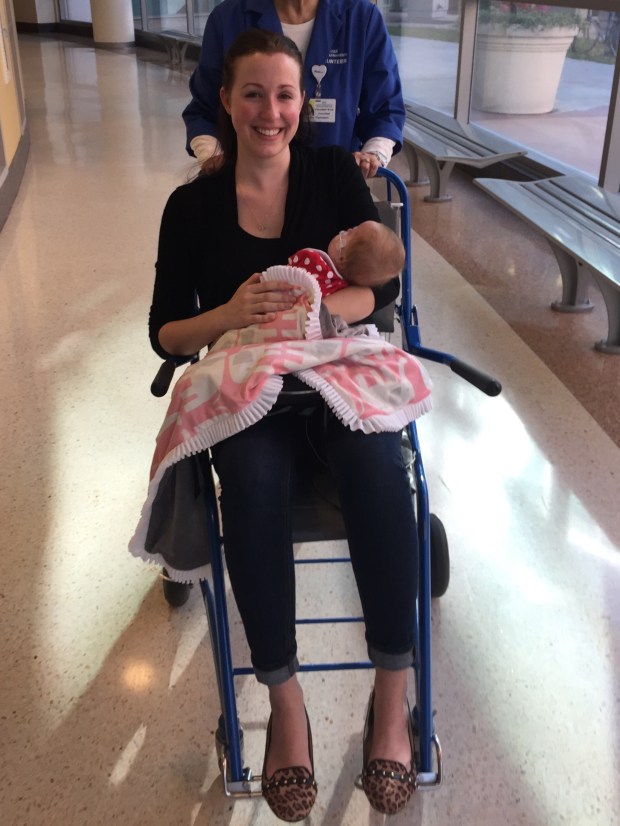
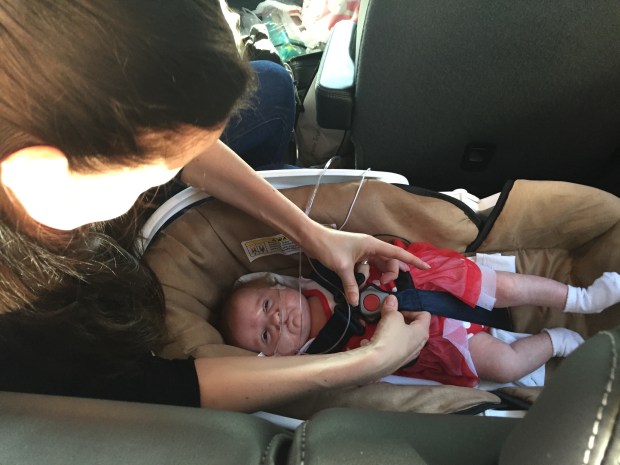
In true to Baby Squirrel form, a discharge date would be set and then moved back. A date would be set and then she would randomly experience apnea over night while in the care of a nurse that wasn’t familiar with her, thus restarting the 5 day waiting period before she could go home. Then she had to pass a car seat test proving she could make the 20 minute drive home safely. Again, against our strict orders, a night nurse performed the test and she failed due to the pads being in the incorrect position causing her oxygenation level to drop.  This presented a huge setback. Now the only way they would let her go home was in a “car bed” which would need to be special ordered. Amazon to the rescue!! This thing felt like a freaking death trap the way it precariously attached in my car but on January 14th, 2015 I got my final wheelchair ride.

IMG_7891

The scariest wheelchair ride of my life!

IMG_7908

Saying goodbye to our children’s NICU aunties and Grandma, their primary nurse, was extremely bittersweet. They had been our family for nearly 5 months. They were the only people in the entire world that knew exactly what we were experiencing every day.  On Baby Girl’s final day I left this letter to her team:

Dear [primary nurses’ names] and ALL the nurses that care for, talked to, played with, held, comforted, and loved our daughter:

We can never repay you or thank you enough for the gift you have given us. Thank you for being [Baby Girl’s] mothers while I could not.

We are so overwhelmed with excitement to finally have our family whole and be able to bond with both our children. You have been our family for the last 4 months. You have witnessed the hardest days of our lives. Your kind hearts comforted us when [Baby Girl’s] mounting prognosis felt dire. You are forever in our hearts every time we look at our beautiful children who have taught us how precious and fragile life can be. I cannot come up with the right words to truly express our gratitude.

We will truly miss all their aunties & grandmas.

IMG_7878

Saying goodbyes 

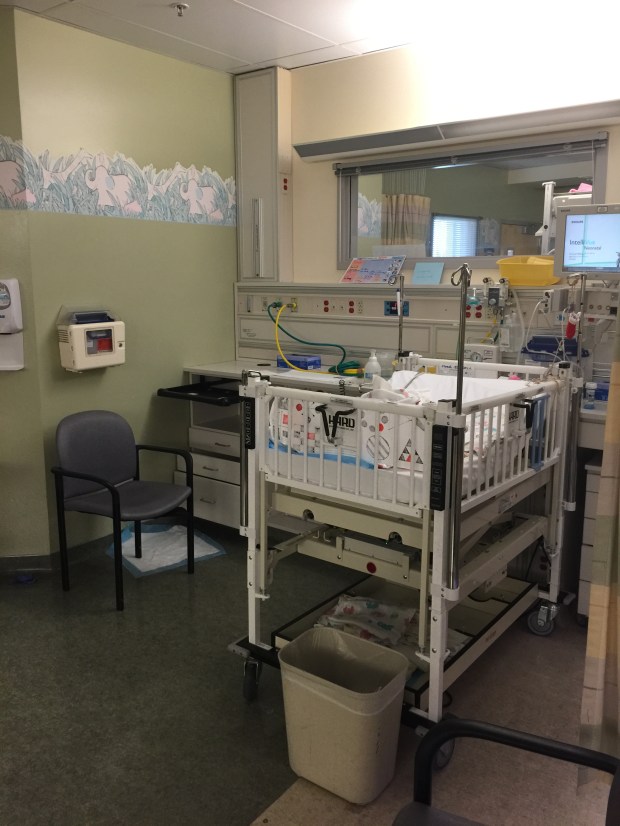
Leaving the NICU my sister took one last picture of Baby Girl’s empty pod…IMG_7877
Still to this day I cannot articulate how morose this photograph makes me feel.

Processed with Moldiv

Baby Squirrel’s Homecoming

In conclusion, over a year later, some days I feel like I am ready to get off Zoloft, I have even reduced my dose a bit.  But then there are times that I’m not sure I could handle caring for all my daughters special needs without it. When Baby Squirrel is happy and smiles or laughs my heart swells with joy unlike anything I’ve ever experienced, it’s so amazing and wonderful and I don’t know how I could love someone so much. But when she is irritable and sick and crying for hours/days on end or shitting and vomiting nonstop I want to shoot myself in the face (metaphorically speaking, I promise.) I don’t want to stay on medication forever but it’s still something I’m struggling with daily.  Currently my daughter is in the middle of another asthma episode.  She wakes up multiple times a night crying inconsolably, coughing and desaturating thus requiring additional oxygen till she can recover.  She doesn’t have a typical cry, due to multiple factors it’s quieter and courser but it burrows into your brain and eats your goddamn soul.  Along with her pulse oximeter and feeding pump we now have to haul her suction machine upstairs every night and back down again the next day.  She requires 30 minutes of multiple nebulizers 4 times a day followed by CPT (chest physical therapy.)  I do all this while also caring for her twin brother, who is now running all over the place and getting into everything, and while trying to keep the house in relative order. I can’t take her anywhere for fear of her catching another cold and landing back in the hospital again (those exciting tales to follow in later installments.)  Which leave me feeling full of regret that my son is missing out on countless experiences because of his sister. This was not intended to be a pity-party or a sob story but rather to paint a picture of my daily reality and why I don’t feel ready to get off my mediation at this time. Maybe I’m weak but our daily life is entirely too overwhelming without a little chemical help.  And on the worst of days bottle-o-wine help. 😉

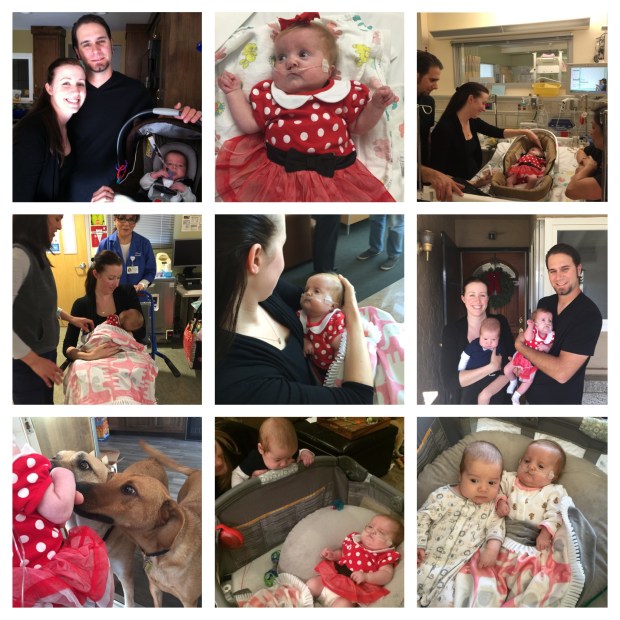
I know this was an exceptionally long post; thanks for sticking with me as I try to bring our story up to speed.  Below are more mostly unshared photos from our time in the NICU.  Coming up next: the twins at home, Baby Squirrel’s long awaited cleft lip repair, and her very real, very close call with death. Processed with MOLDIV

This slideshow requires JavaScript.

Let’s Get Started, Shall We

Welcome to my first post! Please begin by reading the “About” section.

When the seed was planted for this blog, the biggest roadblock, other than coming up with a name, was where to start. Currently my twins, A & A, are 15 months old and so much has happened! How could I begin without explaining where we’ve been, but we’ve been everywhere, including near to death. My daughter, Baby Squirrel, has been through so much that I’ve even forgotten about many of her diagnoses that have been overshadowed by additional diagnoses.

Regret hit me for not starting earlier. Then I recalled I had started earlier. Shortly after the twins were born while they were both still in the Neonatal Intensive Care Unit (NICU), I was in the deep depths of misery. I would spend my time between trips to the hospital scouring the internet for hopeful stories about preemies and VSDs and Dandy-Walker Syndrome, and all the rest of the scary words being thrown at us daily. I remember even googling, “are kids worth it?”  My husband and I had always wanted kids. We had struggled with infertility for a year before having a miscarriage and beginning fertility treatment. I knew I was not OK, I needed help.

The following post I submitted to March of Dimes: Share Your Story:
09/2014
31 Weeker B/G Twins in NICU + Special Needs Child (Cleft lip/palate & Dandy-Walker Syndrome)

Where to begin… My husband and I tried for over a year to get pregnant before seeing a fertility specialist. We had been pregnant once but I had a miscarriage at 8 weeks. Turns out I have PCOS (Polycystic Ovarian Syndrome) and don’t ovulate normally. However, after one round of ovulation therapy (and a warning that we might conceive triplets) I did in fact conceive. At 5 weeks we learned it was twins. The first day we laughed. The next day I cried, all day. I was so scared. One baby is hard enough work on its own. After a few days when it sank in a little we were so excited.

The pregnancy started out well. At our gender ultrasound we didn’t learn the genders but we did learn that Baby A had a cleft lip & probably palate. We were devastated.  At the time it felt like the worst news in the world. Like our world with perfect healthy babies was over. Later we learned Baby A was a girl, I felt so bad for her. I felt like we wouldn’t be able to take newborn pictures of her or want people to see her. Feelings that I feel very guilty about now. After meeting with a geneticist my husband and I decided to get an amniocentesis to find out if either of our twins suffered from any larger chromosomal problems. After the traumatic procedure and 2 very long weeks we learned that our son & daughter were chromosomally  perfect. Over time we met with what would be her craniofacial team and saw how they would help fix her clefts. It was so reassuring and our fears were greatly relieved.  I thought that was the end of our worries.

Unfortunately our baby girls story gets worse. At a later ultrasound we got hit with another huge bombshell – a defect in our baby girl’s brain. They found that our baby had Dandy-Walker syndrome, a congenital birth defect affecting the cerebellum & 4th ventricle. They said it looked mild but Dandy-Walker syndrome can cause physical & intellectual impairment to severe mental retardation. There is no way to see how it will express itself. Again we were devastated. Her brain! No parent ever dreams of having a child with special needs. But every time i worried about her she would give me a kick. Like she was reassuring me she would be fine. Although I was heartbroken I had so much faith in her.

Before pregnancy I always said I was pro-choice and I would never bring a special needs child into the world. But she was already my baby girl. I could feel her moving inside of me. I was shocked when doctors gave us the option for a “reduction” to abort just her. We didn’t consider it for a minute.

My pregnancy continued on. We did research and came to terms with another of her conditions. I had Braxton-Hicks contractions everyday starting in my 2nd trimester. After being evaluated by Labor & Deliver they determined I just had an irritable uterus and lots of contractions were just my thing. Unless they got painful I was OK.

At 31 weeks, 3 weeks into my maternity leave, I started having contractions that felt like period cramps. I tracked them and they became more frequent. I called in and they told me I should go into L&D for observation. At 6pm on 9/3/2014 I was chitchatting with a nurse as she tried to get the heart rate monitors on my belly. She was having a little trouble finding baby A so she went out to get an ultrasound machine. I wasn’t concerned and told my husband to use this time to go move the car and grab my bag in case they wanted to observe me over night. A male nurse came back in and after locating baby A got on his phone and called someone “STAT”. I asked what was wrong but he wouldn’t tell me. A few people entered my room and checked baby A again and called more people in. They told me baby girls heart rate was under 80 and she would have to come out via emergency c section. I was so scared. I tried calling my husband to get him back in the room. They grabbed me and started giving me an IV and telling me about general anesthesia. Right as my husband returned they were rushing me out of the room and down to the OR. Once I was on the table I could feel fast moving hands all over me but couldn’t see anything due to the infamous blue curtain. I was so scared they were going to cut me  open before I was under I kept yelling “I’M STILL AWAKE! I’M STILL AWAKE!”

My babies were born at 6:29pm. Baby girl was 3 pounds 6.3 oz. Baby boy was 4 pounds 5 oz.

I woke up in so much pain. My husband had escorted our babies to the NICU where I wouldn’t see them till the next day.

The next day I was determined to get into a wheelchair so I could see my babies. When I first saw my daughter I was shocked by how big her cleft was. It was completely up and through her nose. That was the least of our worries. Both our babies’ lungs were underdeveloped. It killed me to watch my son fight to breathe. I cried nonstop the first few days every time I saw him. Baby girl had the same condition but didn’t seem to be struggling as much. A few days later when they sent me home they told us to expect them to remain in the NICU for 4-6 weeks. Leaving them was the hardest thing.

During the first week we learned our baby girl ALSO has a hole in her heart. It was presented to us as a very large hole that could require open-heart surgery. I was so scared she was going to die. I ran out of the NICU and collapsed in a chair in the hallway, repeating to my husband “I can’t lose her, I can’t lose her…” Later we met with a cardiologist who explained that although it’s one of the largest VSDs he’s ever seen they usually close on their own in a few years. That he would not operate on it. Due to the hole in her heart her lungs have excess fluid in them making her breathing fast & hard. In order to help with the fluid in her lungs they had to give her diuretics which caused her to lose even more weight. Seeing her so tiny compared to her brother is so difficult.

Now almost 3 weeks later our son is doing great. He is off air and up to 5 pounds. We are working on breast & bottle feeding. Once he learns how to eat he can come home. We all hope that is in the next 2 weeks.

Our daughter has finally started to gain some weight back but she is still a pound and a half smaller than her brother. She struggles to breathe and they change her breathing machines often. It still kills me to see her so skeletal. Holding her is scary due to her small size. Plus she has terrible reflux so her feeding tube had to be pushed down into her intestine. Most days feel like 1 step forward 2 steps back.

As for our daughter’s Dandy-Walker syndrome, her ventricles do not seem to be swelling at this time but the doctors still think she will need a lot of extra help. Its so heartbreaking to hear. I hate having to “wait and see.” I am so overwhelmed with fear of having a child with special needs, let alone having another baby to care for at the same time. I cry most of the days. My husband is so amazing and supportive but I feel like I am drowning in despair.  I have an appointment with a psychiatrist to discuss possible PPD.

I knew our twins would most likely be in the NICU but I never realized how hard it would be. My husband stayed home with me for 2 weeks to help me recover but now is back to work till they come home. My routine is going to 9am rounds by myself. Listening to the doctors talk to each other makes everything sound so scary and I don’t understand most of it. I try breastfeeding my son and then go home and pump every 2 hours. At 4:30pm I meet my husband over at the NICU again. Its so draining. Pumping all the time and going back and forth to the NICU takes up all our time. Our babies aren’t home and I still don’t get time to sleep. I am hoping its easier once they come home.

But I am also terrified of them coming home. I’ve seen them struggle to live. I’ve seen how fragile they can be. I’ve become to rely on their monitors to show me they are OK. I don’t trust myself with my own kids. It might be PPD but I am terrified of being a mom. I’m scared I won’t survive it. I feel like every thing and every thought is overwhelming. I’m terrified of having a child with special needs. But I also don’t want to set up a self-fulfilling prophesy by treating her like she has special needs.

Right now I pray my daughter keeps gaining weight as that will hopefully help many of her health issues.

I just wish I could fast forward in time.

Phew, that was painful to revisit.

In posts to follow I will work on getting you all up to date with all the fun stuff thats happened since their exciting arrival.

Till then,

Processed with MOLDIV

PS. Ironically I don’t think I swore at all in this post. I’ll work on that.