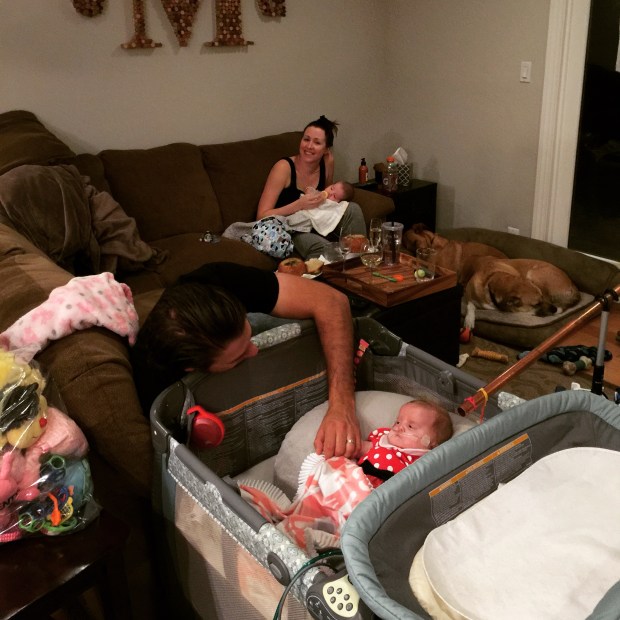
A Year Ago Today

November 19th, 2018:  Just seeing the photos from one year ago come up on my Timehop app makes my heart race and fight or flight kick in. Hello Trauma, my old friend. (Bonus points if you sang that outloud.)

♦♦♦

Addie hates Thanksgiving.

Of the three prior to Thanksgiving 2017, she’d only been out of the hospital and healthy enough to attend one! She’d worn a size 6m onesie as a two year old that said “My First Thanksgiving.” So naturally on November 19th, 2017, just 4 days before we were to host about 20 people at our house, Addie spiked a high fever.

It started low grade for the first 12 hours: 101.3, 99.8, 102.8, 102.5.  Since her cardiac catheterization three weeks earlier, where she was started on a daily aspirin regimen to prevent blood clots from forming on the devices patching the holes in her heart, we could only give her Tylenol to manage her fever.  Normally I would have alternated giving her Motrin and Tylenol to stay on top of it. Throughout the day she remained playful but seemed a little more tired than her usual self.
img_0857

I stayed up with her till 12:30am at which point her fever was 102.6 and I was able to give her another dose of Tylenol.  I then carried her upstairs to her bed where she woke up and began crying as though she was truly miserable. I sat next to her crib and held her hand, and tried to keep a cool washcloth on her.  By 1:30am her fever was up to 103.5 but I still couldn’t give her more Tylenol yet. I continued to sit next to her crib but by 3am I could no longer keep my eyes open and she had settled into a more restful sleep. I checked her temperature one more time, 99.9 *phew!*, and set an alarm for when I could give her another dose of Tylenol.

My husband wakes me up when my alarm starts going off and I get up.  I look in Addie’s crib and she looks awful and is burning up again.  I check her temperature – 105.1!  I wake up my husband and ask him what he thinks I should do since he had been trained as a paramedic in his early 20’s. As he’s getting up to look at her, Addie gasps, contorts, and starts convulsing. She drains of all color, her lips turn blue and foam forms from her mouth. I’ve seen my daughter go through terrible things before, I’ve even had to help hold her down while terrible things have been done to her.  This was truly the most terrifying moment because I had zero idea what to do. My husband was so calm and in control while I was completely losing it.  And for the first time for either of my children I called 911.

img_0862-e1531350625800.jpg

11/20/2017 4:34am

If the notion of me taking this photo concerns you, I agree.  I felt dirty taking it.  But I took it, as well as all the other “hard” photos I’ve shared on this blog, for the purpose of being able to look back and see all she’s overcome.

It was my first ride in an ambulance and Addie’s second, her first being her trip to Oakland at just a couple months old.

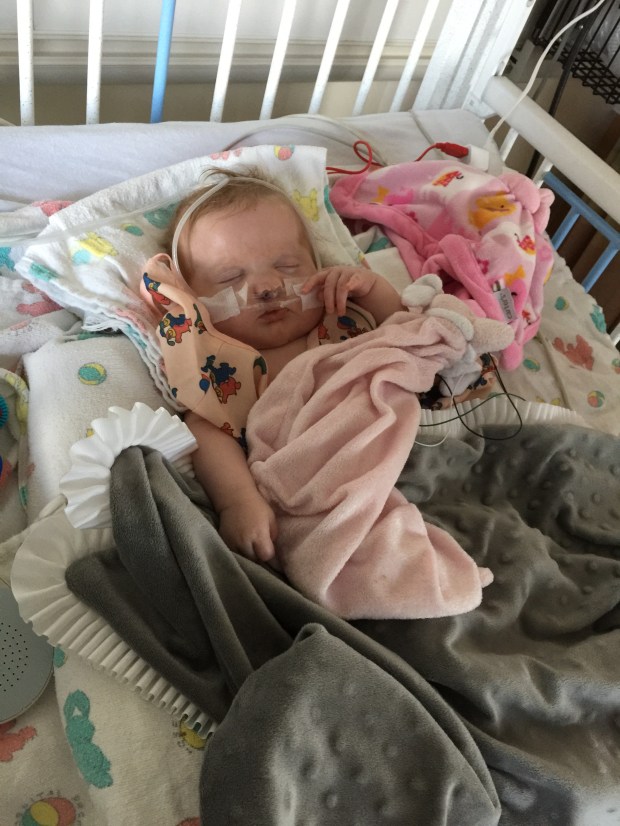
We arrived at the Emergency Department and were greeted by a team ready to take her in.  Due to her age and medical history they took her right into room #1.  I don’t know how other ED’s work, but at ours the lower the number the more severe they consider you. This room was also the same room where they had to drill into her leg bones to get a line when she had septic shock at 6 months old.  Assessments were done, IV was placed, labs were sent, more Tylenol was pushed.  At 8am her fever was back up to 103.5.  Tylenol could barely touch it.  Her labs came back positive for influenza, despite the fact  no one else in the house had been sick and we had all gotten the flu shot.

At some point I got up to wash my hands and the nurse says, “oh, there she goes again.” I turned around to see Addie convulsing again. Drained of color again.  Lips blue again. Foaming at the mouth again. I helped the nurse try to keep Addie’s body on its side while the seizure ran its course.

By then I had been awake for nearly 24 hours, excluding the hour I had slept before her initial seizure. The ER doctor brought me an energy water and snacks.  She would later email me the following day to thank me for being the most collected and helpful mother of a small child she’d encountered in the ER. *humble brag* (Useless fun fact: Since this day I am still obsessed with grapefruit Hi-Ball and drink one almost everyday.)
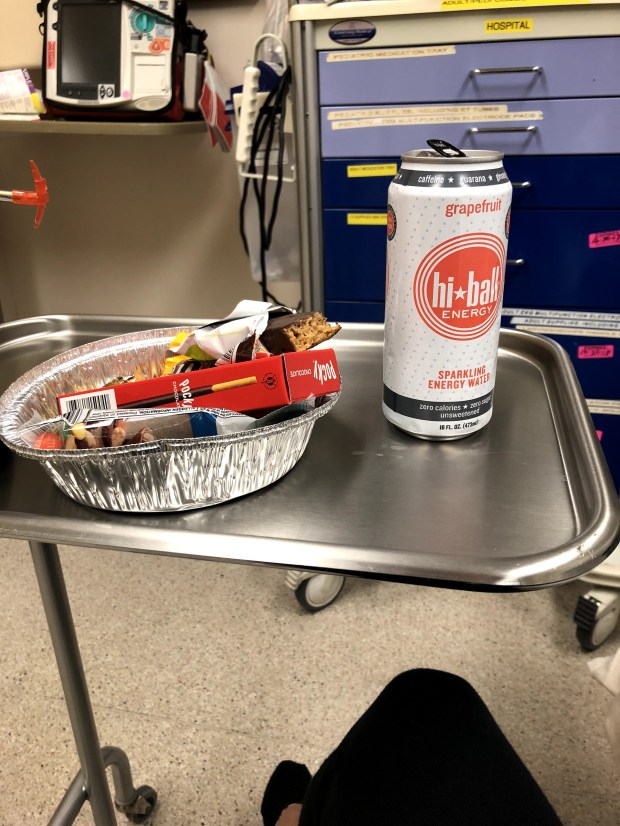
IMG_0863.jpg

11/20/17 5:31am

After the second seizure the decision was made to admit Addie to pediatrics.  It is common for children with high temperatures to have what is called a febrile seizure, however more than one is rare.  Given Addie’s complex medical history the doctors had additional concerns and paged her neurologist.  In the meantime we were wheeled upstairs to the pediatric department and settled into a private room. Shout-out to our private bathroom, a luxury not supplied in the NICU or PICU.
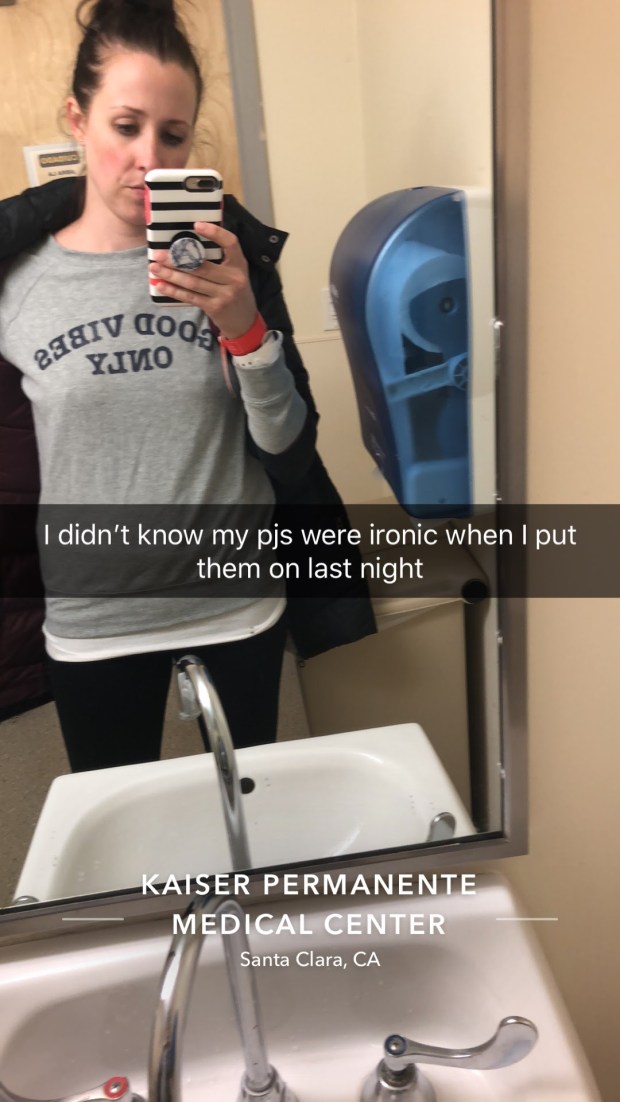
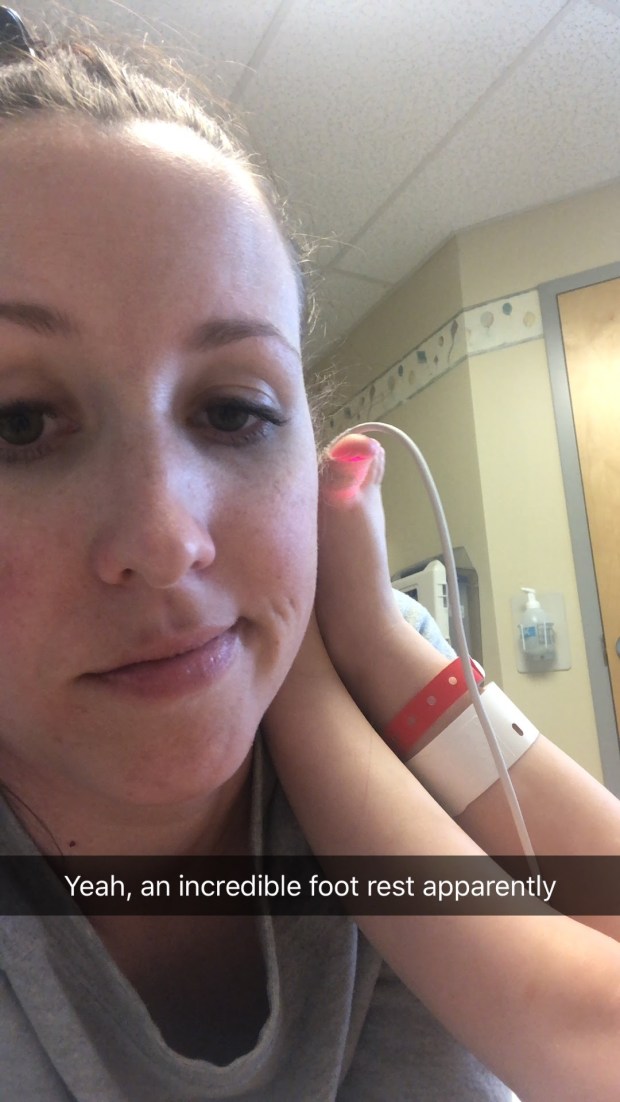
IMG_0864.jpg

IMG_0866.jpg

Making sure she doesn’t fall off the bed.

I tried to curl up at the foot of Addie’s bed to sleep but to no avail.  There were only short rails on the bed so I had to keep a hand on her to be alerted if she moved or rolled towards a side.  Nurses, doctors, and other staff kept coming in to check her and speak with me.  By 11am she seemed to be on the mends.  Her fever was back down to 99.1 and she was resting. However, at 11:30am Addie began seizing for a third time.  I was alone with her this time.  I pressed her call button to get her nurse but it felt like it took forever.  When she came it was over but I reported it lasted 30 seconds.  In reality it could have only been 10-15 seconds.  Time is near impossible to correctly track while in a panic.
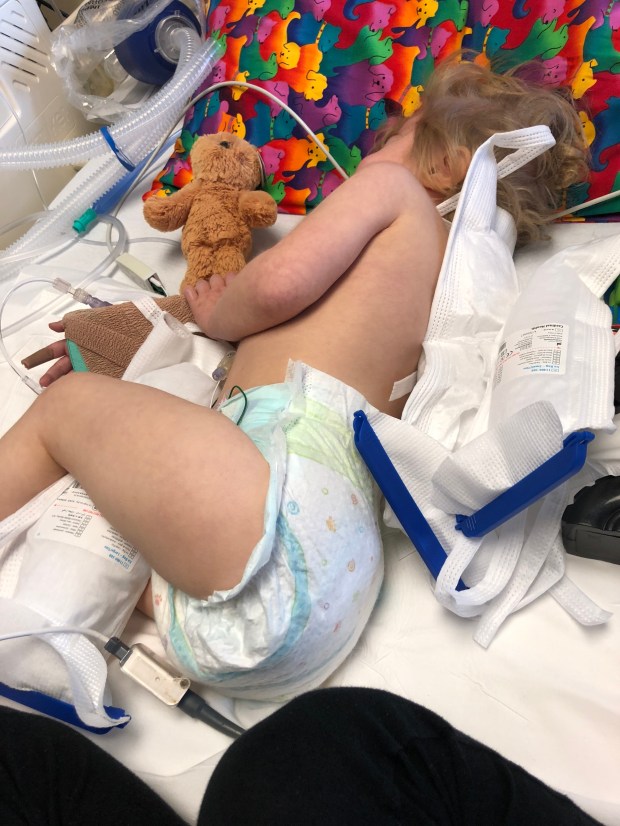
53289946988__4e78bae5-9088-48cf-b56d-069df063d6a6

Applying cooling measures

Each seizure left her exhausted.  Once finished it would take her a moment or so to focus her eyes again and become alert.  Her third seizure increased her doctors’ concerns because more than one febrile seizure is uncommon, and that it was while her temperature was less than 100.  Her neurologist stated that he wanted her, once healthy, to have an EEG to “see if anything has awoken in her brain.” [WTF mate?! What a chill thing to say, amiright?!]

An EEG is a test that detects abnormalities in your brain waves, or in the electrical activity of your brain. During the procedure, electrodes consisting of small metal discs with thin wires are pasted onto your scalp. The electrodes detect tiny electrical charges that result from the activity of your brain cells.

https://www.hopkinsmedicine.org

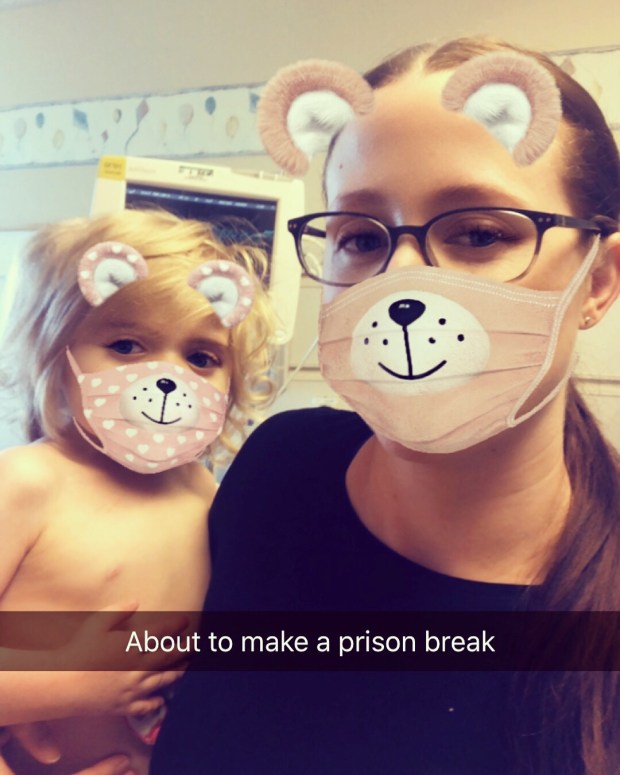
We couldn’t know it but her third seizure would be her last.  Her requirement for discharge became 24 hours without a fever a.k.a. we were spending the night.  I told my amazing mom group what was happening and like always they came to our rescue.  They sent or delivered food and entertainment to pass the time.  Bless them.  Their support never ceases to amaze us.

After 36 hours awake Addie’s ex-teacher of the deaf came to visit.  I’m nearly certain my eyes were rolling back in my head for her entire visit but I was so happy she came.  Addie even showed some love by signing for the lights to be turned off so her light-up Lightning McQueen could shine brighter.

As with our previous hospitalizations, my husband came to spend the night with Addie while my brother and brother-in-law came to drive me and my car home for public safety.

While Addie had still  been in the ER, I called and left a message at her daycare letting them know the situation and that she would not be attending that day, or following days.  After I went home for the evening our favorite nurses from Addie’s daycare came to visit with toys for Addie and comfy socks and blankets for us.  I cried when I later saw what they had gone out of their way to bring us to make our time more pleasant. (Random side-note: I’m rocking the lumberjack socks right now, a year later. Socks are a gift that keep on giving. *wink wink* Honestly, I have a sock problem.)

With all our previous hospitalizations Addie had been in a big pediatric crib.  I loved that she was in a regular bed this time so I could lay with her.  I had been so tired but I didn’t want to pass up being able to lay with my baby.  My husband loved it too but had to request they bring her a crib so he could actually sleep that night.
This slideshow requires JavaScript.

img_0880

waiting for the 24 hour fever free mark
IMG_0883.jpg

11/21/2017: We’re out of here!

Another condition for going home was Addison was started on Keppra, an antiepileptic medication.  Keppra comes with a lot of undesirable side effects (sleepiness/ weakness/ dizziness/ zombiness) but since she had had three seizures they didn’t want to wait and see if she would have more.  She would go home taking it until her EEG to determine if she truly needed it.

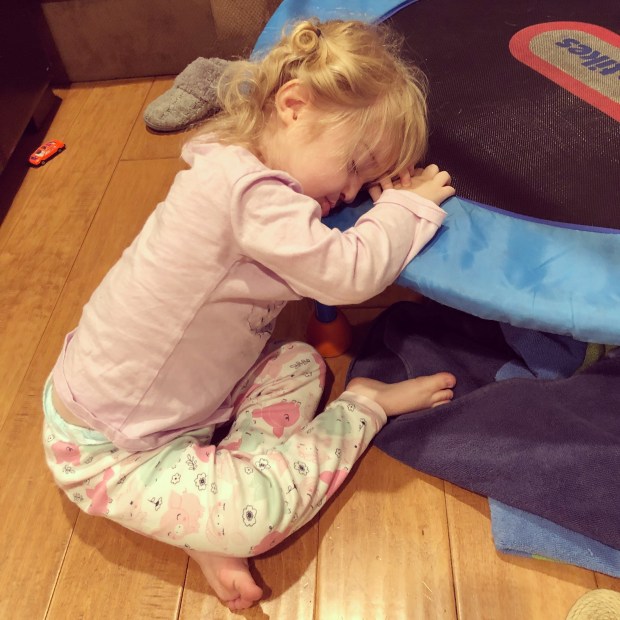
One of her first doses of Keppra at home resulted in her bending forward while sitting indian-style on the kitchen floor and falling asleep in a puddle of her own drool.

 ♦♦♦

December 7th, 2017: EEG Time!

This was my first experience of any kind with an EEG.  They had me wake her up ridiculously early that morning so she would hopefully take a nap during the procedure. The room had a standard hospital bed and the technician asked me to lay down on it with Addie and cuddle her till she fell asleep. HA! Yeah right, Addie is not going to sleep with me, or any one else for that matter, touching her. But we tried.  And nothing is more calming to a toddler than putting goo, electrodes, and cotton balls all over their head then topping it with a tight cap. Zen AF.

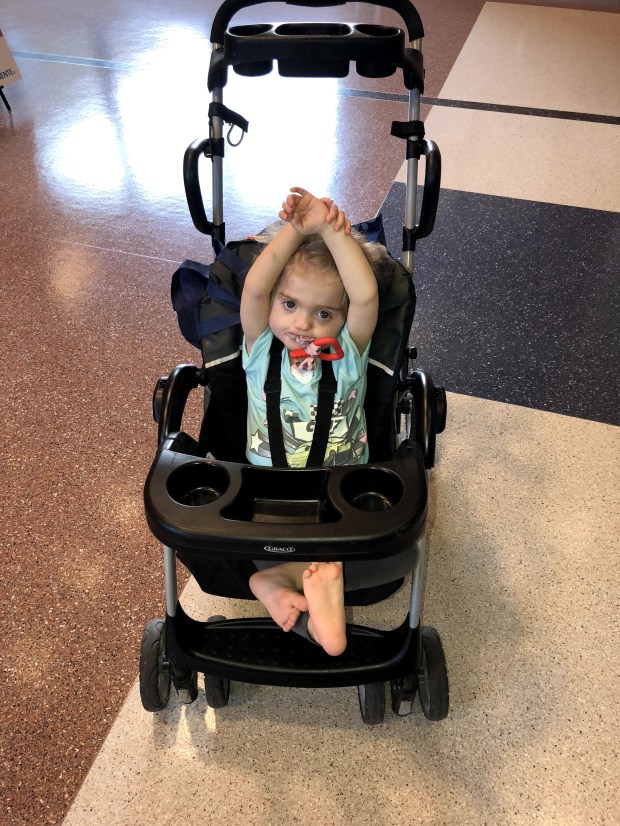
Needless to say an hour later she was still awake and active.  They had already done the strobing light test which thankfully gave neither of us a seizure.  But for the rest of the tests she would need to be asleep.  I was so worried the tech was going to scrap the test and make us come back another day that I was thankful when she went with my suggestion to put Addie back in her stroller since I knew she was more likely to fall asleep there than in bed with me.

I stayed in the bed, the tech turned off all the over head lights and we waited.  She waited, I fell asleep.  Best appointment ever.  I got to sleep for over an hour! And Addie even fell asleep too.  When I woke up I was sure something was wrong because we had been there almost 3 hours at this point.  A doctor came in to look at the readings and her and the tech whispered back and forth.  Every bad thought was going through my head.  Epilepsy, tumors, other terrible possibilities I don’t know about.  I don’t even think they can detect brain cancers with EEGs but that didn’t matter to my brain in the moment.

When the tech finally got everything she needed she removed the gunk and electrodes from Addies hair and we were sent home to wait for our neurologist to contact us with the results.

*drumroll*

Results: Normal.  Stop Keppra.  Rejoice much.

♦♦♦

In 2 days,  November 21st, 2018 will mark one year since Addison was last hospitalized.

An entire year.

Our longest stretch of time.

Nobody jinx this.

I’ll find you.

♦♦♦

This will be HOPEFULLY my last depressing post for at least a while. My next will be an update on all the nonshitty things we’ve been up to! A lot of nonshitty things have happened! Stay tuned.

Processed with MOLDIV

My Daughter Is Deaf

A month after Baby Squirrel was discharge from the PICU after nearly succumbing to septic shock and double pneumonia, we were back at the hospital for a sedated hearing test. The goal being to keep her completely still so we could finally get reliable results.

I was rather optimistic.  We figured she had some hearing loss but we knew she could hear.  I told her primary NICU nurse that there was a chance Baby Girl was Deaf and she reaffirmed that she was not Deaf, that she loved her music in the NICU and always responded to her daddy’s voice. Even the audiologist that attempted to check her hearing while she was sedated in the PICU believed she could hear because Baby Girl turned towards her when she entered her room out of her line of sight.

My best evidence for her hearing was at home one night when I was putting her to bed, my husband, who was downstairs, spoke through the baby monitor and Baby Girl started looking behind her for him. Yet there were other times when she was napping in the living room and I dropped a pan loudly on the ground and she did not stir.  Evidence for her lack of hearing I chopped up to her being used to so many loud noises from her long stay in the NICU.

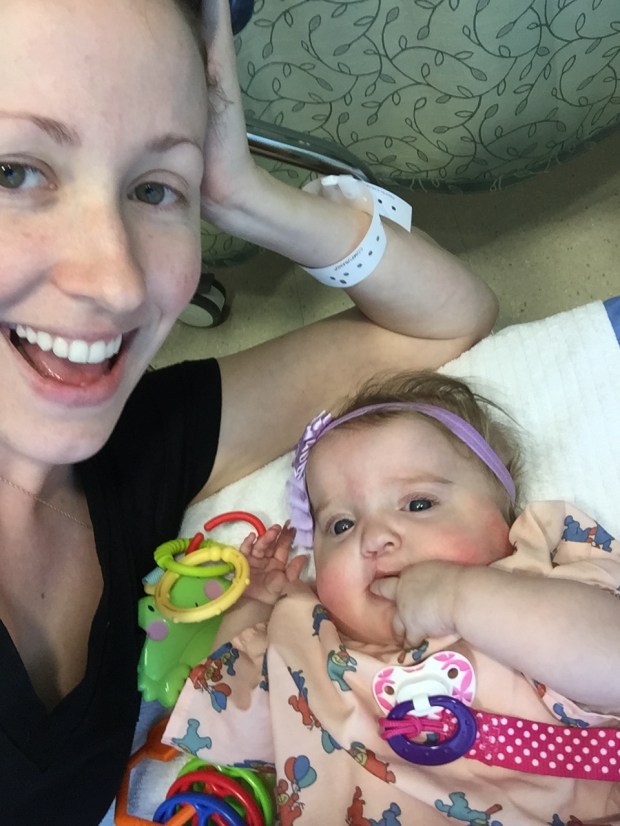
Baby Squirrel’s procedure took place in the same department as my D & C had a year and a half prior. Everyone commented on her being the littlest patient they had in quite a while. Even the smallest infant size gown they had hung off of her. In the photo below you’ll notice she was off oxygen.  Around this time she was able to come off often and use it only at night while she slept. Now a year later, this nearly never happens. She’s much bigger now and with the increase in size comes an increase in our hopes that she would be outgrowing her lung disease.  If she comes off oxygen now, even for a few minutes, the oxygen in her blood desaturates and she struggles to breathe and turns mottled and blueish. At the current age of 1 1/2, they now expect her to need oxygen till the age of three. *sigh*

IMG_9997

When the time came, we went into the procedure room and I sat with her while the nurse tried to start an IV. The attending physician was one of Baby Girl’s PICU doctors (now I jokingly call him “Uncle Ben”).  When the doctor and the audiologist were ready I was sent back out to the waiting room to, ya know, wait.

The test took about an hour and then I was brought back into her room for the results. Baby Squirrel’s hearing loss was “Profound.” Meaning she can’t hear. Anything.  They tested both ears up to 120 decibels, equivalent to a jet taking off – painfully loud for a person of “normal” hearing. Nothing. The test rendered no response.  My heart sank a little but I remember not being surprised.  The audiologist said she may have some success with hearing aids, and if we wanted additional testing, an MRI could tell us if she is a candidate for cochlear implants.  Before the audiologist left she told me to keep talking and singing to her.

“A cochlear implant is a small, complex electronic device that can help to provide a sense of sound to a person who is profoundly deaf or severely hard-of-hearing. The implant consists of an external portion that sits behind the ear and a second portion that is surgically placed under the skin.”
-National Institute on Deafness and Other Communication Disorders

ear_works2

How cochlear implants work


Typically, to avoid major speech and language delays in a child with hearing loss, it needs to be identified and hearing aids need to be in place by six months of age. Baby Squirrel was now over 7 months old.

A few weeks later I took her to get fitted for hearing aids.  She absolutely hated the forming putty being injected into her ear, she screamed and thrashed. This audiologist was so patient and kind, considering both twins were screaming their heads off. I ordered Baby Squirrel hot pink hearing aids – if you can’t hide it, rock it!  As we waited for her hearing aids to be made, we moved forward with having an MRI of Baby Girl’s brain.  The MRI would look for the presence of her auditory nerves.  It was scheduled for my 30th birthday. I prepared for the best birthday present, or the worst.

IMG_0758

After MRI and a lot of attempted IVs

IMG_0761

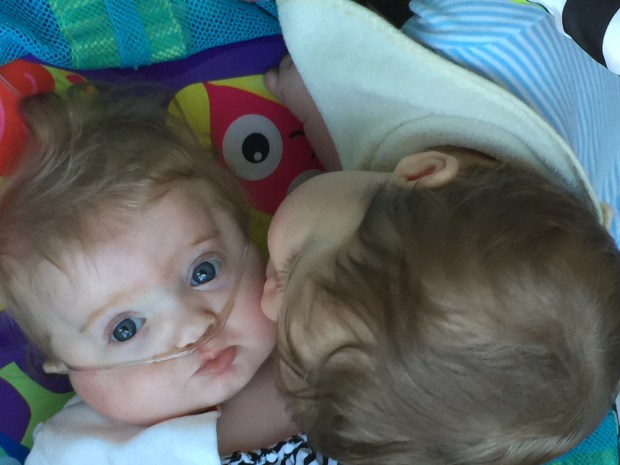
Baby Boy had lots of kisses for his sister when we got home

The MRI went smoothly.  Our favorite doctor from the PICU, Dr. F,  was the attending physician. After, when I was allowed to go back and see my daughter, she was happy and smiley, obviously still enjoying the sedatives. She was covered in tape and gauze where they had attempted multiple IVs since her veins were still so small. Unfortunately, I would have to wait for the ENT specialist to review the images before I would be informed of the results. I emailed her to make sure she saw that the MRI images were ready for her, and sat back and waited to hear from her.

Nothing that day.

Nothing that night.

Nothing the next morning.

So many hopes and dreams depended on these results!

Still nothing.

That night in the middle of my workout session, my phone finally rang.  I was annoyed that she had picked this time to finally call but I was relieved it was her, the ENT.

“I had a chances to review your daughter’s scans…It looks like your family should start learning to sign…I do not see an auditory nerve on either side.”

“Okay…” I said staring out the window at our unmanicured backyard.

The ENT continued to explain that due to the absence of Baby Girl’s auditory nerves, she was no longer a candidate for cochlear implants. Without the auditory nerves there was no path for the implants to communicate sound to her brainstem.  She mentioned a new alternative option called an ABI but stated Baby Girl was probably not a candidate for that either due to her Dandy-Walker Syndrome variant.

An auditory brainstem implant (ABI) is a small device that is surgically implanted in the brain of a deaf person whose auditory nerves are lacking or damaged. The auditory nerves conduct the sound signals from the ear to the brain. The implant enables otherwise deaf people to have a sensation of hearing.

The hearing sensation is limited, but the implant recipients are relieved of total sound isolation, facilitating lip-reading.

The auditory brainstem implant consists of a small electrode applied to the brainstem, a small microphone on the outer ear, and a speech processor. The electrode stimulates vital acoustic nerves by means of electrical signals and the speech processor digitally transmits the sound signals to a decoding chip placed under the skin. A small wire connects the chip to the implanted electrode attached to the brainstem. Depending on the sounds, the electrode delivers different stimuli to the brainstem making deaf people hear a variety of sounds.

Due to the brain surgery required for the implantation and the limited effectiveness of the implant, the number of implant recipients is small.

http://www.hear-it.org/auditory-brainstem-implant

So that was it. Our daughter was deaf and there was nothing we could do to change that.

I’m guessing you are wondering, as we were, then why did everyone think she could hear? Why did she respond to sounds that were out of her line of vision?  Why did everyone report how much she loved her music?  Welcome to the club! And that is why Baby Girl/Squirrel has another nickname: Alien Mystery Baby.  Nothing about her seems to make sense, she leaves many of her doctors scratching their heads, and most tests leave us with more questions than answers. I’ve had doctors ask out of medical curiosity if they could follow her for their own education. I used to like to joke that someday her condition would end up in medical books bearing her name: [Baby Squirrel] Syndrome.

When I got off the phone with the ENT I expected to cry but I didn’t.  As I try to remember what my immediate feelings were, my chest fills with weight.  I had been trying to prepare myself for this possibility for weeks, months, but I was pissed.  We were devastated.  I know that to the Deaf community, that can be offensive, but Paul W. Ogden, author of The Silent Garden: Raising Your Deaf Child acknowledges that your child’s deafness is a crisis, at first.

“…a crisis is an occurrence that permanently alters our understanding of reality; frequently it is an event we have not anticipated or prepared for.  Something happens that throws everything we know, feel, and understand about our lives and those around us into a new light. I don’t have to tell you that learning of your child’s deafness is this kind of experience… For the child who has been deaf from birth or shortly thereafter, nothing has altered.  For you, life has changed permanently… Simply understanding that you are in the process of adjusting to a fundamental change in reality can be helpful.”

The best way I can describe it is, every time we get a new dire diagnosis for Baby Girl, I mourn the loss of the life I had envisioned for her.  Starting with the first diagnosis of a cleft lip in utero, I mourned her perfect face, adorable newborn photos, happy smiles, a normal appearance that wouldn’t give kids an added reason to make fun of her. I had to exchange those images I had dreamed of for many painful surgeries, years of speech therapy, dental surgeries, multiple cosmetic surgeries, all in the hope that someday people won’t notice she was born imperfect. I have lost the life I envisioned for her countless times.

“Losses are…occurrences or events that shatter dreams that are core to a person’s existence…  The initial diagnosis often marks the point when a cherished and significant deam has been shattered for the parent… The parent oftentimes does not understand that it is a dream that he has lost, and therefore he is frequently confused by the grief process that follows.”

-Kenneth L. Moses, psychologist

We didn’t want to tell anyone that our daughter was Deaf at first; we didn’t want it on social media.  We called and told close family members and everyone was sad.  Probably a month or more went by before we told ourselves our daughter is Deaf and that’s not going to change, so why hide it?

The whole time in the NICU, what got me through was the thought that someday she could tell me she was OK. I know that her inability to speak won’t keep her from being able to tell me that someday, but the vision was to hear her voice. Now it feels like everything is thrown up in the air.  The twins are now a year and a half old and our hearing son is signing but Baby Girl shows very little interest. More recently she enjoys watching people sign the ABC’s, 1-10, and my made up “Good Night”song for her when I tuck her in at night. She likes holding hands and touching faces, but most of the time she won’t look at you when you want her to and will pull her hand away if you try to help her make sign shapes. It breaks my heart when I see other twins babbling back and forth.  How much I wish that was A & A; I eagerly await the day they sign back and forth. Thinking about it just makes me more anxious about Squirrel’s lack of interest in communicating.

When we tell people she is Deaf, the usual response is something like, “really? Aww, I’m so sorry!”  And we dive into our spiel about how the Deaf community doesn’t consider being Deaf a disability, how we’ve always wanted to learn sign language, how we’re excited to have a bilingual family, yadda yadda yadda. Sometimes I feel that way, but sometimes I hate it. Some people apologize for trying to talk to her verbally, don’t apologize, we still do too.  Whenever there is tragedy or sadness people always try to say magical reassuring phrases. Don’t do that. But I’ll get into that in a future post. One that we get often is along the lines of future technologies, “Well in the future I’m sure they’ll have someway to make her hear.” Maybe, but most likely she wouldn’t benefit from it.  She was born Deaf, she’s never heard a sound, ever.  Her brain is being mapped for visual information. If she heard sound, in say 20 years, her brain wouldn’t know what the hell to do with it.  She would need years of therapy to learn how to hear, what sounds mean.  I hope that if that technology ever is available that by then she is so well adjusted she wouldn’t need to subject herself to the hassle.

I have so much to say here and nothing.  My feelings regarding my daughter’s deafness is fluid and evolving.  This part of our story has such a far way to go. Sometimes I truly am optimistic about it.  This is the best time ever to be born Deaf; with so much of our communications digitalized already, job are limitless. But I’m still scared about where she will fit in in life.  Deaf children are more likely to have other disabilities than the general population; however, the Deaf community has also worked very hard for generations to dispel the notion that Deafness in itself is a disability, and therefore some try to distance themselves from Deaf people with disabilities so as to not be perceived as a disabled person by association.*

When Baby Girl was discharged from the NICU, she was enrolled in many state and federal funded programs due to her prematurity and health issues.  Shortly after she was discharged from the PICU, the Early Start Program, in conjunction with the San Andreas Regional Center (SARC), sent interventionist to our home once a week to play with and observe and assess Baby Girl’s development.

The Early Start Program is California’s response to federal legislation ensuring that early intervention services to infants and toddlers with disabilities and their families are provided in a coordinated, family-centered system of services that are available statewide.

Once we learned she was Deaf, SARC transferred her from the county level Early Start program to our local school district with interventionist and teachers for children with hearing loss. An Individual Family Service Plan (IFSP) is created every 6 months to formulate developmental goals for Squirrel based on her own abilities.  Now once a week her teacher/interventionist comes to “play” with her and track her development. And every other week her awesome ASL teacher comes and works with all of us.  She shared with me that she gets really excited when a new Deaf child enters their program, but has to remind herself the parents might not feel the same way.

Processed with Moldiv

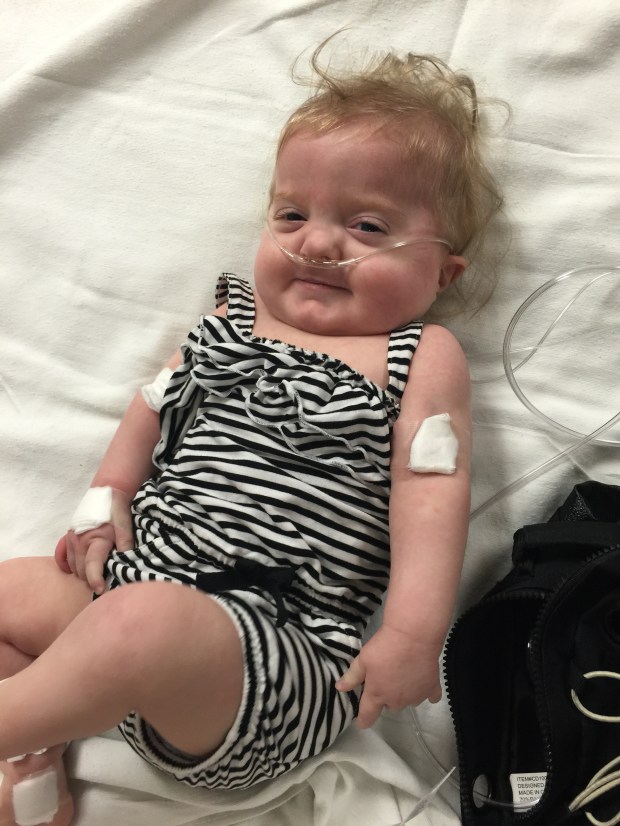
Baby Squirrel at 9 Months Old

It’s not all bad.  It is fun learning ASL, I just wish it wasn’t because we HAVE to.  And it’s helpful having Baby Boy be able to tell us what he wants since his verbal vocabulary is still small. It’s just one more thing on top of the mountain of other things.  I am relieved she’ll never have to endure those school bus hearing tests though.  From unrelated causes, I have poor hearing and the school bus tests were always humiliating for me when I was the last student let off the bus.  There are definitely pros and cons to Squirrel’s deafness.

  • Pros
    • She can sleep through anything
    • We don’t have to watch what we say around her – For example…
    • We can mute Caillou
    • Our protective dogs don’t wake her when people fail to read our “No Solicitors” sign
    • She could get a service dog someday!
  • Cons
    • We can’t get her attention if she can’t see us
    • We can’t startle her out of a bad behavior by yelling
    • You can’t communicate while doing other tasks with your hands
    • She won’t be properly embarrassed by our “80s on 8” renditions
    • She runs the risk of not overhearing enough dysfunction to be funny

Our house is covered in Sign labels.


Aside from my friend’s stepdad in elementary school, my daughter was the only other Deaf person I had ever met. Watching my friend sign with her family had left an impression on me, and ever since I had always wanted to learn sign language.  In college I tried to take American Sign Language but I couldn’t register because I was not a Special Education major.

Over the past year we have tried multiple avenues to learn sign language.  We had to first decide whether to learn American Sign Language (ASL) or Signed Exact English (SEE).  ASL is a fully formed true language with its own grammar and syntax, where SEE is English with a sign for every word. We ultimately decided that it was most important to give Squirrel a basis in real language and chose to learn ASL.  My older sisters and one of my nephews are learning SEE at our local school for the Deaf and Hard of Hearing. My nephew tells me everytime I see him that he hopes Baby Girl learns to sign and her oxygen and feeding tube goes away so she can have a normal life. *tear*  He’s 8 and he told me he was so sad when he found out she couldn’t hear. Me too, Buddy.

My husband and I tried online tutors, and watching DVDs, but being in the house with the kids is too much distraction.  This spring semester I began taking an ASL course at our community college. Three hours every Monday night.  It’s already been so helpful to get out of the house and immerse myself in the class without interruption.  My professor is Deaf and speaking is forbidden in class.  I was surprised by how much I already know.

I didn’t actually get into the class at first.  I was 6th out of 13 on the waitlist, and she only ended up taking the first four.  Since it was the first day of class most communication was written on the chalkboard.  I got up and wrote asking if I could audit the class, just sit in the back and watch.  She signed no, there was no room, nothing she could do. So I put down the chalk and I signed, “My daughter is Deaf.” She told me to sit down and handed me an add code at the end of class! The Deaf culture is collective, they take care of their community and share any information they can to help Deaf people communicate and interact with the hearing world around them.  By helping me she’s helping my daughter.

I’m not one to believe in fate or really anything divine, but something along the way happened that I truly am thankful for, and kind of in awe of how perfectly these people came into our life. While I was pregnant our hospital enrolled us in a prenatal group called “Centering.” It was awkward at first but we were all due around the same time so slowly we bonded over common pregnancy symptoms, and the dads bonded over how crazy all the moms were. Just kidding, they bounded over sports and other off topic subjects. There was even another couple having twins.

I was the first one to pop. But exactly a week later, while we were visiting our babies in the NICU, we ran into a couple of familiar faces.  The other couple with twins delivered their boys at 32 weeks and they were also in the NICU. We got closer over time, mostly from seeing each other in the NICU all the time, and going through a similarly difficult situation. It was nice to have people we knew there.

After all the Centering group babies were born everyone met back up for a reunion, Baby Boy was home by then.  We exchanged information and started meeting once a month for playdates.  These families have turned into an extended family to us and our kids: aunties, uncles, best-friends growing up together since before they were born.

The coincidently perfect part is, the mother of the twin boys has many Deaf family members and was raised with ASL as her primary language.  You know who you are, and it still makes my eyes misty to remember the first time we brought Baby Squirrel to your house, and as we were leaving you knelt down infront of her car seat and signed to her.  I have no idea what you said, nor is that important.  But I don’t think you have any idea what that meant to me. Thank you.

This chapter is open ended – this part of our journey is still just beginning.  Stay tuned for updates.  Including upcoming posts about more things for people to stare at, and getting a genetic diagnosis!!!!!!!

Processed with MOLDIV

*If you have a child recently diagnosed with hearing loss, I highly recommend reading The Silent Garden: Raising Your Deaf Child, by Paul W. Ogden.

Home, Surgery, PICU & Death: Part 1

This post may not be for the squeamish or hypersensitive. I have included unpleasant photographs and videos showing post-surgical incisions and extreme medical treatments. This post also includes an outsider’s account of the death of a child. That being said, the story I am going to share was profoundly traumatic for our family, leaving invisible scars that may never heal.

The day Baby Girl came home, January 14th, 2015, was wonderful and terrifying. For 4 1/2 months we had relied on her monitors to tell us exactly what was going on with her, and if something happened the nurses and doctors were right there to intervene. The nurses had told us from day one not to rely on the monitors but to watch her coloring. We quickly learned “dusty” = bad.  Nothing is more nerve racking than the moment when those monitors go off and her life, that you have seen first-hand be extremely fragile, is thrust into your hands.

IMG_7983

1/14/2015: First night with both babies home

Please notice the copper rod with colorful rubber bands near her head.  What you can’t see is her feeding tube hanging from it. We would jury-rig many ways to feed her over the months to come, thankfully they became more sophisticated than this.  Probably the hardest thing that we had not been prepared for was the witching hour. Or what you would all call 7:00PM. Every single night at this time Baby Squirrel would start crying and sweating uncontrollably for a solid hour.  One of us would have to sit with her and hold and lower her feeding tube as needed.  We tried everything to comfort her but eventually, for our own sanity, settled on wearing headphones till the episode passed.

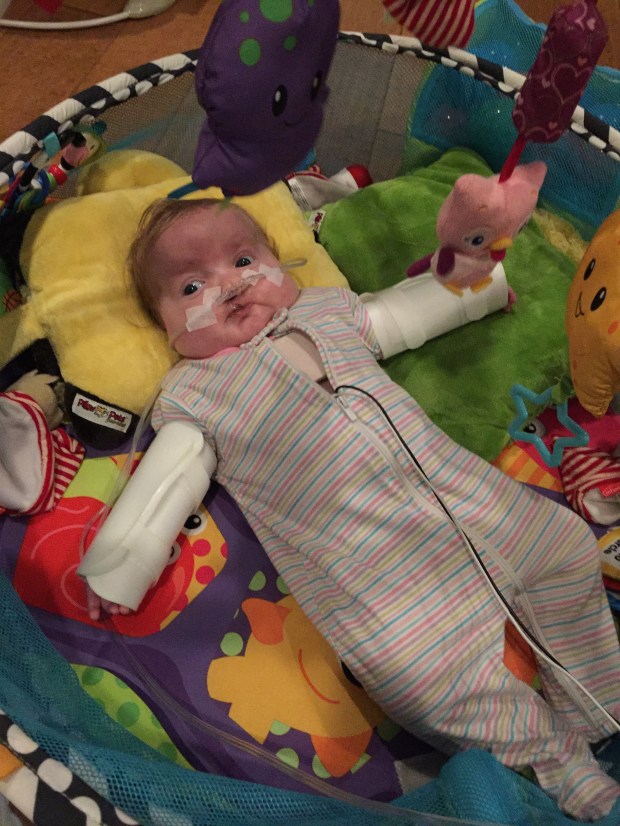
They had sent us home with an apnea monitor, not a pulse oximeter monitor, meaning we couldn’t see exactly what her oxygenation level was or exactly what her heart rate was. Instead it would just beep at us incessantly if her heart rate got too high or too low or she held her breath for more than 15-20 seconds. I don’t think we ever took her monitor off her that first week.  Two days after she came home she had doctor appointments, and I remember unloading all her equipment from the car into her stroller and thinking, no baby should require all these cords, people are probably staring. That day we met with her plastic surgeon (yes, my daughter has had a plastic surgeon since before she was born, NBD) and he cleared her for the surgery we had been waiting for for nearly 8 months, since I was 4 months pregnant, the surgery to repair her cleft lip and nose. (Insert Clueless quote here.)  She had been the first baby in her NICU to have a special tape placed across her cleft. (The name of the tape is alluding me now as I celebratorily spiked it into the trashcan when she no longer needed it.) Starting shortly after she was born the special tape was placed on one cheek and stretched across and adhered to her other cheek.  The purpose of this tape was to pull her gums together, closing the large opening in her gums due to her cleft palate, and to stretch the lip skin so there would not be excess tension on the incision once her cleft lip was repaired.

Five days later we were back to meet with her anesthesiologist for the surgery and an Ears, Nose, and Throat specialist to discuss placing tubes in her ears during the same surgery. I will explain later the reason for the tubes. While we were in the waiting room waiting for this appointment, Baby Squirrel had a giant blow out! (That’s a poop explosion for any non-parents.) She hated being dirty so she was losing her mind. Her monitor starts shrieking out in the quiet waiting room because her heart rate was over 220! Thats really high, especially for something like a dirty diaper. For the next few weeks, and year really, we would spend an average of 3 whole days a week at the hospital seeing her various specialists (pulmonologist, gastrointestinologist, physical therapist, occupational therapist, ENT, neurology, though ironically rarely her pediatrician because her care was so complex.)

When we were home we tried to make up for missed time. There was already a significant developmental gap between the twins but we tried to put them together as much as possible.  From spending more than 4 months on her back in a bed her head had become asymmetrically flattened on one side, but most discouraging was she hated to be held.  She would throw such a fit she would have respiratory distress if you tried to hold or cuddle with her. I worried perhaps she was autistic but through speaking with other long term NICU parents, I established it’s fairly common among infants that begin their lives not healthy enough to be held. Even at home, her dislike for being held, plus her great need for growth and therefore strict feeding schedule, had her propped up in her crib for many hours of the day yet again.

As you can probably imagine, it was nearly impossible to bond with her under these circumstances. Since they were born we dreamed of bringing them both home and bonding as a family.  However, when Baby Girl came home she became more of my patient than my daughter.  Not only did she not like to be held, but due to her cleft lip she was never able to breastfeed. So my daughter and I never got to have that magical skin-to-skin breastfeeding induced oxytocin love fest. At nearly 5 months she still didn’t smile so there was no positive feedback.  I loved her in the sense that she was my daughter and my flesh and blood, and when bad things happened to her my heart would physically ache, but it came no where close to the love I felt in my bones for her brother. Judge if you must, I don’t like to admit that. It left me feeling extremely guilty and unfair.

Before either of my children were discharged from the NICU hearing and vision tests were performed as prematurity can greatly effect both areas. Both of their visions were fine, however Baby Girl’s hearing test continually came back inconclusive, “Refer” to be specific.  We weren’t too concerned because we knew she loved her music and always responded to her daddy’s voice.  Upon her discharge from the NICU she was referred to an audiologist to have her hearing rechecked.  This appointment did not go well as it required me to hold her, and hold her still – it wasn’t happening.  The audiologists did not believe the results were accurate so we rescheduled our appointment to repeat the test and if it still was inconclusive a sedated test was an option.

A week later was Baby Girl’s cleft lip repair surgery.

Before I start writing any of my blog posts I do research.  I go through all the photos and videos on my phone from the target time and read through anything I may have written in my calendar or elsewhere. As I mentioned in the beginning, this time period was particularly traumatic, and this is apparent to me because a lot of the photos and videos I have little to no memory of. In addition, many days I have no documentation to refresh my memory at all during this time because there were days I could barely bring myself to look at my daughter.

Tuesday, February 10th, 2015, at 6:30am we arrived at the hospital and Baby Girl was admitted for surgery.  We were able to go back with her to get her changed into a gown and wait for the surgeon to come speak with us.  We laid the twins together and they fell asleep. Still to this day she is calmed by his presence.

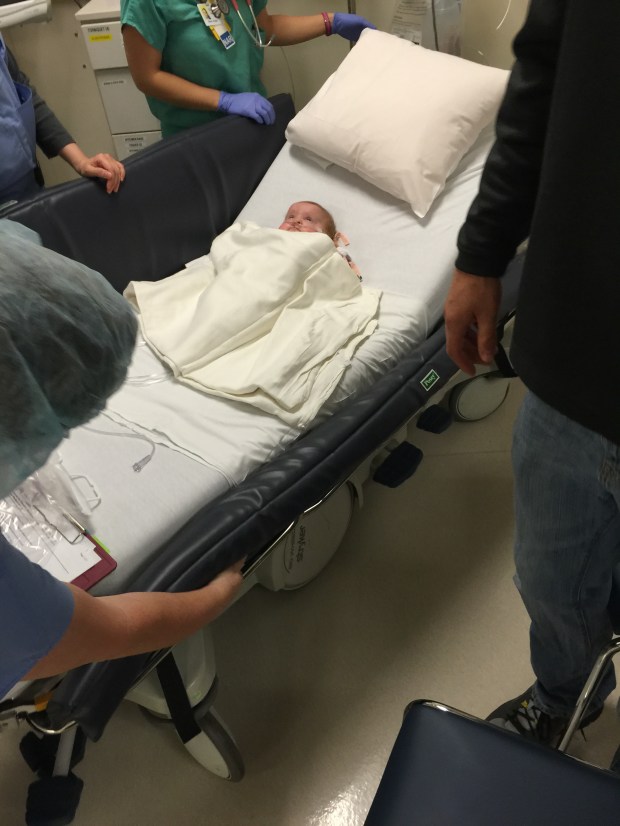
When the time came I took one last photo of her being wheeled to surgery because there was a little voice in the back of my head wondering if this would be the last time I’d see her alive. All surgeries come with the possibility of complications, no matter how routine,  plus I am a mother, the mortality of my children is never far from my mind.

IMG_8377

2/10/2015 – Baby Girl being wheeled away for surgery

I can’t recall exactly how long her surgery took but it was quite a few hours.  Eventually the plastic surgeon came out and reassured us that everything had gone smoothly and he was really happy with the outcome. We were then directed to Recovery where we would be reunited with our daughter.

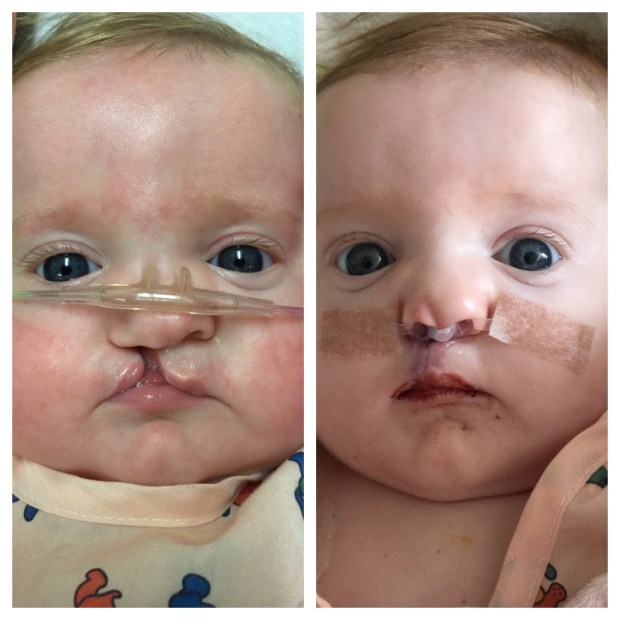
Saddest lil’ face you’d ever saw, right?!
But it was also the most amazing! The surgery had completely reshaped her face.

IMG_8385

2/10/2015: Her amazing Before and After

Once she was cleared from Recovery we were transferred to the PICU.  This was our first time stepping through the big mysterious metal doors.  We arrived with our daughter the first time but anytime we had to reenter we had to ring a door bell and announce to the nurse behind the camera who we were and who we were visiting.  I was first struck by how much smaller it was than the NICU.  There was a centralized nurses/Doctor station on the right surrounded by 7 private rooms with sliding glass doors on the left and back.

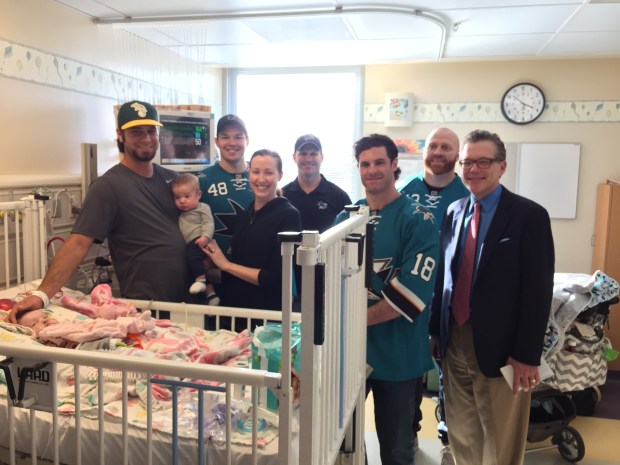
She was in a lot of pain but plastics came to check on her and reassured us again that the surgery went perfectly and she was given Hydrocodone/Hycet for pain.  As our luck would have it the local hockey team the San Jose Sharks were visiting all the children in the pediatric wing that day, something they do often.

IMG_8388

2/10/2015: The San Jose Sharks visit all the children in the Pediatric wing

By that night the doctors felt she was recovering well and transferred her out of the PICU and out to the Pediatric floor. In the PICU the nurses have 1-2 patients. In general Pediatrics the nurses have…I have no idea because we rarely saw a nurse after her move.  So of course that’s when the fun started.  Baby Girl started screaming and crying and didn’t stop.  Her ear-splitting monitors wouldn’t stop going off as her heart rate remained over 220.  When the nurse would come to check on her there was nothing they could do for her unless it was time for more pain medication. We resolved to taking turns pacing the halls as a mental health break. Eventually I took Baby Boy home for the night and my husband stayed with her.  I would return in the morning to bring her home.

When I arrived in the morning Baby Girl looked like hell and her coloring didn’t look right.

IMG_8396

2/11/2015 – waiting for discharge papers, she didn’t look right to me

My husband had left for work by the time I got there but mentioned the crying had lasted all night.  As her discharge paperwork was being compiled, her nurse and I simultaneously noticed her  MIC-KEY button had come out! The balloon filled with water that holds it in place had ruptured. The feeding tube was still pretty new to me, I had never had to change one on my own.  Down the line I would become a super badass g-tube changing pro, but till then I panicked.  I knew this commonly happens but I also knew that if the stoma (the hole in the skin through which the MIC-KEY button enters the stomach) were to close she would require another surgery to replace it. We were able to put it back through the stoma and tape it in place until I could get my brother-in-law to go by my house and bring us a replacement button.  Hours later I finally had my crying miserable baby home.

For the rest of the day she cried and cried and cried. Then magically the next day she seemed OK. She stopped crying and showed interest in her toys and playing. It was a good day.  We still had to keep the arm restraints on her so she wouldn’t touch her lip or nose.  Unfortunately, this was just the calm before the storm.

IMG_8405

2/12/2015 – Arm restraints so she wouldn’t touch her lip and nose. This was actually a good day, she had energy to play and seemed to be feeling better

That night the witching hour struck and struck hard. Except it wasn’t just an hour, it lasted all night.  We kept calling the surgical department and advice nurses and they kept telling us what she was experiencing was normal after a surgery like hers and to continue with the pain medication. She had only been home for 3 weeks before her surgery so we were still learning her but I had a strong feeling something really wasn’t OK. We didn’t have a pulse oximeter and strangely enough they hadn’t taught us how to listen to her lungs.  That’s right, our child had chronic lung disease and pulmonary hypertension and we had not been taught how to listen to her lungs, we didn’t even have a stethoscope at the time.  At that time we were completely unprepared for recognizing respiratory distress.  Paired with the advice nurses telling us that this was normal.

By 3:00AM my husband and I were at our wits end.  Baby Girl was clammy, had a mild fever of 101, eyes rolling around in her head – not a pretty sight.  At the time her oxygen prescription was 1/8 of a liter of 100% oxygen. That’s barely anything. But with our inexperience, and lack of a proper monitor, we didn’t know if she needed more. We called the advise nurse again and said straight up, “something isn’t right, this isn’t just pain.” We were given an appointment with her pediatrician first thing that morning.

For the ride there I turned her oxygen up to 1/4 liter, still not much but double her usual requirements.  She actually appeared more peaceful on the ride but was still lethargic and clammy.  While the nurse was taking her vitals like temperature and oxygenation level, under the florescent light of the pediatric clinic she looked extremely pale. Her oxygenation level was 75%…because she has pulmonary hypertension her oxygenation level really shouldn’t be below 95% for any extended period of time.

Once the nurse put us in our room I honestly think she went and grabbed the pediatrician away from another patient because she came in only a moment later. She took one look at her and in her best calm doctor voice, the one they use when you know they are actually really concerned, she asked, “how high does the oxygen flow go on her tank?” “Four,” I replied. “Go ahead and turn her up to four.”  She asked me more questions and before I knew it she was asking a nurse to bring in a wheelchair STAT. (“STAT” is never good. “STAT” was used when the ultrasound found Baby Girl’s heart rate was under 80 leading to their emergent birth. I don’t like “STAT”.)  It literally happened so fast. A wheelchair was brought in, they threw me in the wheelchair, Baby Squirrel in my arms, and that nurse RAN me across the campus to the Emergency Department where they had a room waiting in the super emergency section.  The rooms they leave empty unless their use is truly warranted. (The toothless nipple-popping presumed crack whore complaining about all-encompassing pain while continually asking for more food, whom which we would see on a future ER visit would not get one of these rooms.)  A flood of nurses, doctors, and specialists followed.

While they began looking her over and trying to find veins to start an IV, I tried to reach my husband and tell him to get there. He was over the hill golfing (please don’t judge the guy, he thought, like the advice nurses, that she was just in pain from surgery and it would subside over time.)  I can’t remember if I reached him right away or if we played phone tag, my adrenaline was seriously pumping at this time. Thanks to good ol’ Zoloft I had my head together though.  I wasn’t crying and I was able to converse with the doctors and answer their questions, all using that calm facade voice.  Baby Girl had tiny veins and had always been a hard stick.  I hated to see them pin her down while they fished for veins but it wasn’t the first time.

A coordinator called me out into the hallway to sign standard forms while they continued trying to get an IV started. While trying to call my husband again I saw a nurse with what looked like a power drill and thought in the back of my mind that that was odd but nothing more. As I was putting my phone back in my back pocket a nurse came up behind me and grabbed my shoulders softly and told me that they were going to drill into my daughters leg bones to try to start an IV that way. What the serious fuck?! At that instant I saw through the open glass sliding door the drill touch down on her right leg. I turned away and collapsed to the floor. I exploded into wails with my head on my knees and my fingers clasped behind my head.  The nurses scooped me up and sat me in a chair.  I would later find out the IO wasn’t successful the first time and they had to try again on her other leg.

I don’t remember much after that.
Baby Girl and I were moved back up to the PICU.
My husband arrived 20 minutes later from 30 minutes away.


To be continued…

Processed with MOLDIV